1. GOVERNING RULES & EVENT STRUCTURE
1.1. CHUMPCAR INTERNATIONAL INC. DBA CHAMPCAR ENDURANCE SERIES
1.1.1ChumpCar International Inc. is a membership organization (“Social Club”) doing business as (DBA) the ChampCar Endurance Series.’
1.1.2ChumpCar International / ChampCar Endurance Series Membership: Membership is open to ALL without restriction. Full membership in ChampCar requires an annual dues payment and is valid 12 months from the date of purchase. Full members shall be issued a membership number and a printable membership card. Event memberships are also available. Event members will purchase a temporary membership at the track, which will be valid only for the duration of the event for which it was purchased. This membership will not grant voting rights to the member, as they will not be considered a full member.
1.2. SANCTIONING BODY OPERATIONS
1.2.1ChampCar shall adhere to the Basic Club & Competition Rules (BCCR)
1.2.2The BCCR shall govern all ChampCar events sanctioned by ChampCar. ChampCar may revise the BCCR or issue supplements to it, and all rules stated herein may be amended at any given time in writing or verbally at any event (and put into writing at a later time) at the sole discretion of ChampCar based on maintaining safety, equity in competition, cost reduction, or clarification. The interpretation and application of the ChampCar BCCR by ChampCar officials shall be final and binding.
1.2.3All Members of ChampCar International Inc. shall uphold the Basic Club & Competition Rules (BCCR) to promote, elevate, and enhance the name, brand, and reputation of the organization, including its staff, Board of Directors, sponsors, and all those affiliated in any way with the ChampCar Endurance Series. Any act ruled detrimental to the organization, as determined by the Club’s Board of Directors, may result in an action by the Board.
1.3. CHAMPCAR GENERAL RULES
1.3.1Release and Acknowledgment Forms: Members must sign a ChampCar release, annual gear waiver, and acknowledgment agreement.
1.3.2Event Credential: All drivers and crew (“crew” includes all non-driving attendees, including but not limited to family, friends, and guests) must obtain a color-coded wristband from ChampCar at registration. Track restrictions shall take precedence over ChampCar general access allowances.
1.3.3WARNING: This is racing. Racing is dangerous. Your car may be damaged or destroyed at any time. You may be injured or killed. Do not participate in a race, in any capacity, if you do not understand this, and do not get into a race car without thinking about this.
1.2.3.1The naming of teams for entry into ChampCar events is open to anything the team chooses, but may not include obscene, indecent, or profane language. If it can’t be said around small children, it can’t be used in your team name.
1.3.4Insurance: ChampCar carries and provides insurance for facility and event liability; however,
ChampCar is NOT your primary health insurance provider. ALL COMPETITORS MUST HAVE PERSONAL HEALTH AND/OR MEDICAL INSURANCE TO COVER THEIR MEDICAL NEEDS (ambulance transport, initial medical screening, etc.). YOU SHOULD NOT BE ENGAGED IN DANGEROUS ACTIVITIES SUCH AS AUTO RACING IF YOU DO NOT HAVE ADEQUATE PERSONAL HEALTH INSURANCE PROTECTION. PARTICIPANTS THAT DO NOT HAVE INSURANCE WILL BE PERSONALLY LIABLE FOR FINANCIAL CHARGES AND FEES ASSOCIATED WITH ANY MEDICAL CARE.
1.3.5Organizer Decisions: ChampCar decisions are final and not subject to discussion, negotiation, definition, or argument.
1.3.6Unsafe Vehicles: At ChampCar’s sole discretion, any car may be deemed unsafe for competition and removed from the event at any time.
1.3.7Unsafe Drivers: At ChampCar’s sole discretion, any driver may be deemed unsafe for competition and removed from the event at any time.
1.3.8Disqualification from Race: If you have hidden or concealed anything on your car that is illegal in any way, OR violated ChampCar’s rules, OR failed to meet the spirit and/or intent of ChampCar’s rules, or you have seriously and repeatedly violated the event’s driving safety rules, your car may be disqualified from the event. The act of disqualifying any car may occur at any time. Notification shall be issued by a ChampCar official to the Team Manager (or another representative).
1.3.9Track Damage Liability: Teams entered in ANY ChampCar event shall be liable for any and all damage their car may have caused to the event facilities, race track, paddock, pit lane, race track safety barriers, and/or race track equipment. ChampCar will pass the cost onto the team captain with a 4% service fee.
1.3.10Event Changes: ChampCar reserves the right to cancel and/or alter the location, date(s), format, length, credits, and/or schedule of any event based on conditions, circumstances, or matters that are beyond the control of ChampCar, or for any reason whatsoever. This may include, but is not limited to, weather, track safety conditions, car count/entry participation, track surface conditions, or changes issued under track contractual agreements that (in the opinion of ChampCar) would significantly detract from the overall safety, enjoyment, track time or services of the event.
1.4. WINNERS AND AWARDS
1.4.1The car that completes the most laps (after all penalty laps and laps completed are tabulated) shall be declared the Winner.
1.4.2Podium-winning cars do NOT need to be running at the checkered flag.
1.4.3ChampCar’s world-famous trophies will be awarded at ALL events, regardless of the number of entries.
1.4.3.1The top three in each class (excluding EC) will receive a Class Trophy.
1.4.3.2A team representative MUST be present at the awards ceremony to collect any trophy or award.
1.4.4Credits: Unless otherwise stated in the Supplemental Rules, all winnings shall be issued in Credits. Credits are exchangeable and may be applied to ChampCar event entry fees, transponders, Flagtronics, or garage rentals. Race credits expire two years from the date of issue.
1.4.4.1Credits cannot be used to pay for track damage, ChampCar products, SWAG, or other fees. However, they MAY be bartered, traded, or transferred.
1.4.4.2Credits shall be issued as an award to the overall winners in these amounts:
1.4.4.2.1For events 19 hours or longer:
First Place $1,400, Second Place $1000, Third Place $800. Total: $3,200.
1.4.4.2.2For events between 11 hours and 18 hours:
First Place $1200, Second Place $800, Third Place $600. Total: $2,600.
1.4.4.2.3For events 10 hours or less:
First Place $800, Second Place $600, Third Place $400. Total: $1,800 (Total $3,600 for a Double-7 weekend)
1.4.4.2.4For all events, fourth place $200, 5th place $100.
1.4.4.3Credits may be accumulated.
1.5. NATIONAL CHAMPIONSHIP
1.5.1An annual National Championship event will be held at a track designated by the CEO.
1.5.1.1To qualify for the National Championship, a ChampCar team must:
A. Finish in the top 75 in points for the previous season.
B. Teams must compete in at least three (3) event weekends.
1.5.2The winner of the National Championship:
All qualified teams carry their top three (3) season finish points into the Championship, which will be used for seeding purposes.
The championship is a winner-take-all event. Win the race to win the Championship.
1.5.3Bring the same car you raced to qualify for the Championship.
1.5.3.1If a Championship-qualified car is totaled during the season, a replacement car can take its place in the Championship, provided the new car is the same generation, make, model, and options as the original qualified car. The new car must be inspected by ChampCar tech and approved as a qualified replacement.
1.5.4A minimum of TWO (2) original team drivers from one or both qualifying races must complete at least one championship race lap.
1.5.5Championship events are NOT exclusive; anyone can enter.
1.6. NATIONAL CHAMPIONSHIP POINTS SYSTEM
1.6.1One point per finishing position will be awarded to all competing teams. For example, 1 point for 1st, 2 points for 2nd, 3 points for 3rd, etc.
1.6.2Points will be calculated based on the top two (2) finishes for each team. All other finishes will be dropped.
1.7. REGIONAL CHAMPIONSHIP POINTS SYSTEM
1.7.1ChampCar will recognize four (4) Regional Championships. Events count toward the region in which they are held:
1.7.1.1South Region: Road Atlanta, Daytona International Speedway, Sebring (Summer), Sebring (Fall), Atlanta Motorsports Park (AMP)
1.7.1.2Texas Region: G2 Motorsports Park, Harris Hill (Spring), Harris Hill (Fall), Ozarks International Raceway, Circuit of the Americas (COTA)
1.7.1.3East Region: Dominion Raceway, Watkins Glen International, Lime Rock Park, Virginia International Raceway (VIR), Pocono Raceway
1.7.1.4Midwest Region: Gingerman Raceway, Autobahn Country Club, Mid-Ohio Sports Car Course, Road America, Ozarks International Raceway
1.7.2Eligibility Requirements
A team must enter a minimum of three (3) event weekends within a single region with the same car to qualify for that region’s championship.
1.7.3Race Count
Each race is scored individually. A double-enduro weekend counts as two (2) race results.
1.7.4Championship Announcement
Regional Champions will be determined and announced at the conclusion of the final race within that region. Attendance is not required to win.
1.7.5Scoring of Results
Only the team’s three (3) highest finishing results in that region will be scored. (Teams may compete in more than three races to improve their scoring total.)
1.7.6Determining the Champion
The Regional Champion will be the team with the lowest total points from their best three (3) race finishes.
1.7.7Tie-Breaker Procedure
In the event of a tie on points:
The team with the higher finishing position in any race where the tied teams competed head-to-head will be declared the winner.
If still tied, the 4th-best finish will be compared, then the 5th, and so on, until the tie is resolved.
1.7.8Scoring Method & Dual Championship Eligibility
Regional Championship points are awarded using the same system as the National
Championship (1 point for 1st, 2 points for 2nd, 3 points for 3rd, etc.).
Teams may earn points toward both the National and Regional Championships simultaneously.
No separate registration or forms are required—eligible participation automatically counts
toward Regional scoring.
2. ELIGIBILITY
2.1. DEFINITION OF A 500-POINT CHAMPCAR
2.1.1Race entry is limited to mass-produced (over 1,000 units), four-wheeled vehicles certified for US or Canadian street and highway use at the time of the vehicle’s manufacture.
2.1.2No kit cars.
2.1.3ChampCar will assign all competing vehicles a Vehicle Performance Index (VPI). The Vehicle Performance Index is a point value that is based on the Performance Evaluation of your car. In order to compete for the overall win, all vehicles must maintain a total point value of 1000 points or less, as described in Section 4 of the BCCR. Vehicles with total point values between 500 and 1000 points will receive penalty laps.
2.1.4The vehicle’s original, manufacturer-stated curb weight may not exceed 4,200 pounds.
2.1.5The Event Director reserves the right to transfer ANY competition vehicle from the 500-point ChampCar classes to the Exception Class (EC) at ANY time. This rule shall only be invoked under extraordinary circumstances.
2.2. DEFINITION OF AN EXCEPTION CLASS (“EC”) CAR
2.2.1The Exception Class or “EC” car class is open to “ChampCar compatible” cars that wish to race with ChampCar but exceed the 1,000-point limit or any team not wishing to compete for the overall win.
2.2.2ChampCar reserves the right to deny entry to any EC car if ChampCar determines the car to be excessively superior in power, braking, top speed, or other factors that ChampCar feels would be unsafe or disruptive to any event.
2.2.3EC cars shall not be eligible for prize money issued by ChampCar. However, ChampCar will award the class-winning car a separate EC class trophy.
2.2.4EC vehicles must meet all ChampCar rules and regulations for vehicle eligibility.
2.2.5EC cars will display in live timing during the race with an “EC” in front of their name. At the conclusion of the race, EC results will be uploaded separately from the ChampCar Podium results.
2.3. ENDURANCE RACING CAR CLASSIFICATIONS
2.3.1Within ChampCar’s endurance racing program, there are six (6) classes of racing:
CLASS A – All cars with an engine displacement of 1.91 liters and under
CLASS B – All cars with an engine displacement between 1.92 liters and 2.4 liters
CLASS C – All cars with an engine displacement between 2.41 liters and 3.91 liters
CLASS D – All cars with an engine displacement of 3.92 liters and higher
CLASS EC – All exception class cars
CLASS F – All cars with a total as-raced VPI of 300 or less
2.3.2A, B, and C class vehicles with forced induction engines shall be classed in the next higher class (A -> B, B -> C, C ->D). Class D vehicles remain as Class D, e.g., a 2.2-liter turbocharged vehicle will be Class C.
2.3.3Non-turbocharged rotary-powered cars shall be placed in Class B. Factory-turbocharged rotaries shall be placed in Class C.
2.3.4Non-EC Class cars are referred to as cars competing for the “ChampCar Podium.” The ChampCar Podium is for all cars competing under the Vehicle Performance Index (VPI) classification (see Section 4). The ChampCar Podium is for the top-placing cars in the event, regardless of class.
2.3.5Any car not on the VPI list must get the Event Director's approval to race and will run in EC class.
2.3.6Class F cars are NOT in Class A through D. Teams wishing to compete for the Class F trophy must declare Class F prior to the race start and display the applicable Class F decals on their vehicle.
2.4. DRIVER AND CREW ELIGIBILITY AND LICENSING
2.4.1All drivers must be ChampCar members.
2.4.2All drivers must have a valid state-issued or international driver’s license
2.4.2.1Drivers without a state-issued or international driver’s license may be allowed to compete, provided they can demonstrate extensive road racing experience with another sanctioning body (including karting).
2.4.3First-time road race competitors who are novices are required to attend a ChampCar driver’s school session. The driver’s school is free.
2.4.3.1Definition of “NOVICE”: A novice (first-time road racing driver) is someone who has not
competed in a ChampCar or other sanctioning body-organized road racing event in the last two years and/or does not hold a valid competition license. Solo, autocross, drifting, club track days, or HPDE events do not apply to competitive road racing experience, regardless of what license you may have.
2.4.3.2Driver schools are held after registration. The time and location will be announced in the event’s supplemental rules.
2.4.4Drivers under 18 years of age may compete if all the following conditions are met:
2.4.4.1Contact the Club CEO with your request to drive in an event. Provide detailed records of your driving experience. CEO approval must be secured before anyone under 18 can drive in a CCES event.
2.4.4.2The minor driver’s parent or legal guardian must be present at the event. A legal guardian must present a copy of his or her court-ordered status as a legal guardian.
2.4.4.3The minor driver’s parent or legal guardian must sign a “waiver of liability” form on behalf of their child competing in the event (form available from ChampCar).
2.4.4.4The parent or legal guardian must be present at all times the minor is on track, including the driving surface and the “hot pit.”
2.4.4.5The Event Director may limit the number of minor drivers allowed to compete at any event.
2.4.4.6Any contact that a minor driver is involved in will be reviewed by the CEO and may result in driving privileges being lost until the age of 18.
2.4.5Any individual 16 years of age or older may be a crew member in the “hot pit” area, but only if all the following conditions are met:
2.4.5.1The minor crew members’ parent or legal guardian must be present at the event. A legal guardian must present a copy of his or her court-ordered status as a legal guardian.
2.4.5.2The minor crew members’ parent or legal guardian must be present to sign a “waiver of liability” form on behalf of their child serving as a crew member (form available from ChampCar).
2.4.5.3The minor crew members’ parent or legal guardian must be present at all times the minor is on track, including the driving surface and the “hot pit.”
2.4.5.4The Event Director may limit the number of minors allowed to crew at any event. The track may restrict “hot pit” areas to those over 18 at certain events; if so, the information will be in the Supplemental Rules for each event.
3. SAFETY SYSTEMS
3.1. ROLL-CAGES AND SUPPORTING STRUCTURE
3.1.1A quality, well-fabricated, full roll cage is required. Roll cages may be weld-in or bolt-in. Roll cage tubing joints may be welded or bolted, provided bolt-in methods meet conventional safety standards. Roll-cage design and construction must maintain typical SCCA/NASA standards.
3.2. ROLL CAGE DESIGN
Figure A
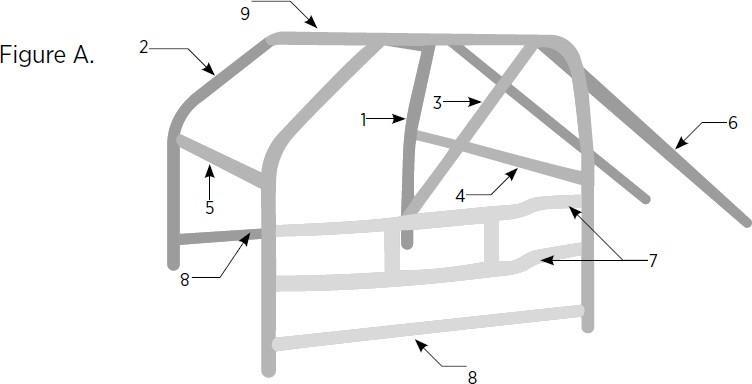
3.2.1The main hoop (behind the driver, labeled “1” in Figure A) must be the full width of the cockpit for all cars. It must be one continuous length of tubing with smooth bends and no evidence of crimping or tube wall failure.
3.2.1.1A 3/16” inspection hole must be drilled in the main hoop so that a tech inspector can measure its wall thickness without obstruction.
3.2.1.2On all closed cars, the main hoop must be as close as possible to the roof (in height) and “B” pillars (in width)
3.2.2The halo hoop (labeled “9” in Figure A) may be constructed of either a U-shaped bar appropriately attached to the main hoop and two front vertical legs (labeled “2” in Figure A) OR front vertical bars bent rearwards at the roof line, connecting to the rear main hoop and cross-braced horizontally along the upper windscreen line.
3.2.3To prevent cockpit intrusion, two driver-side door bars are required (labeled “7” in Figure A). NASCAR-style (Figure A) or Double-V style is recommended. NASCAR and Double-V designs must contain two continuous/unbroken bars. An X-design containing one unbroken bar and one interrupted bar (Figure B) is acceptable with appropriate reinforcement.
3.2.3.1X-design door bars in which one leg of the X is interrupted at the center of the X are permitted when appropriately gusseted and accompanied by a continuous/unbroken sill bar. (Figure B) ChampCar recommends using two unbroken bars if possible.
Figure B
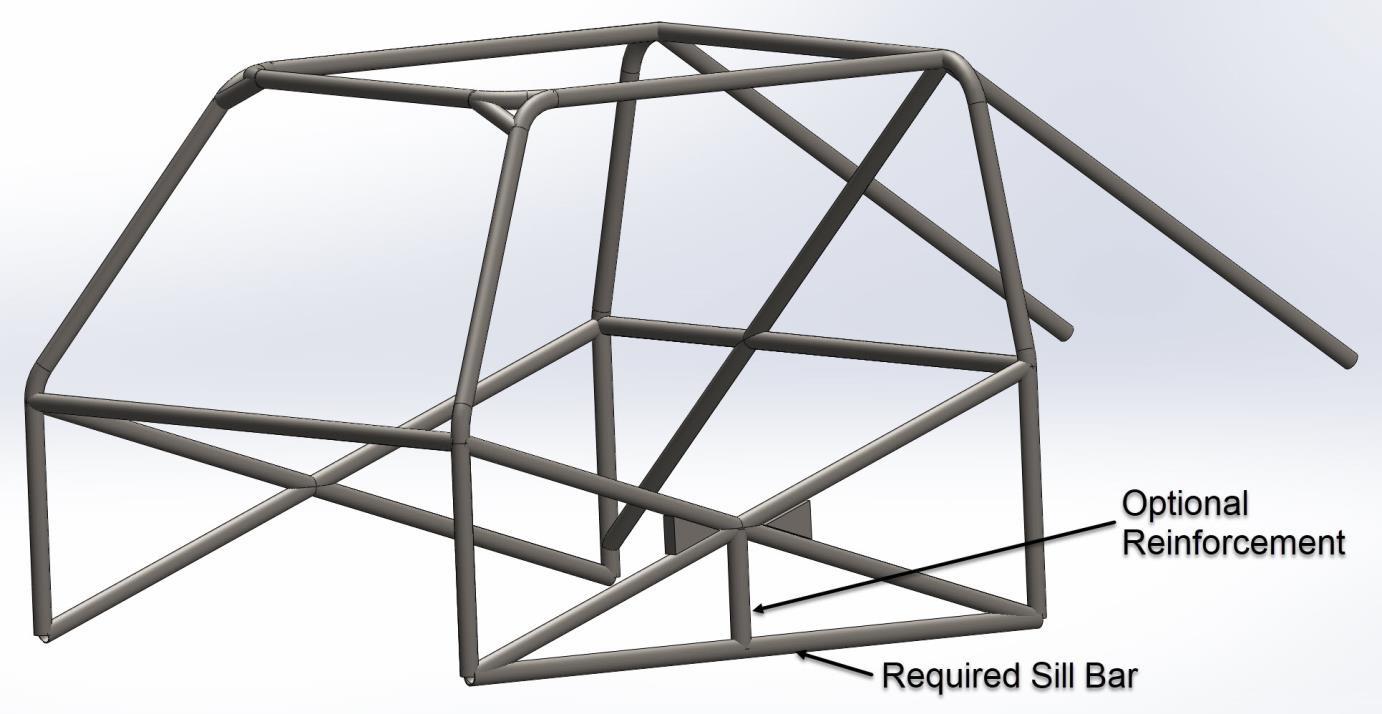
3.2.3.2A minimum separation distance of 4.5” is required between the uppermost and lowermost door bars at the junction to the A and B Pillars. Refer to Figure C.
Figure C
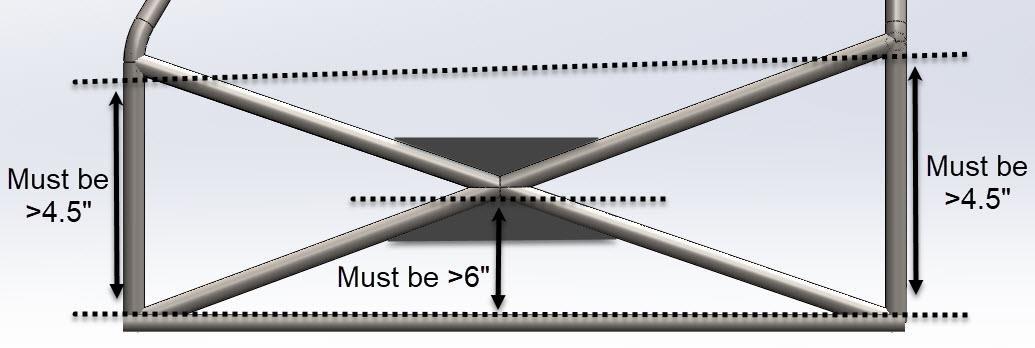
3.2.3.3The upper door bar shall not be placed higher than the bottom of the driver’s window, and at its lowest point must be at least 6” above the door sill. For X-design, the joint must be at least 6” above the door sill. Refer to Figure C.
3.2.3.4If the distance, measured at any point between the highest portion of the door sill or floor pan (whichever is higher) and the lowest edge of lower door bar is greater than ten inches (10”), a floor or lower-sill intrusion bar (labeled “8”), mounted as low as possible on each side of the roll-cage, at or just above the door sill, joining the front vertical legs and the main hoop is required.
3.2.3.5A minimum of one (1) door bar shall be required on the passenger side. This bar can be a floor, a sill, or a mid-level door-bar.
3.2.4Appropriate main-hoop rear supports (back-stays, labeled “6” in Figure A) with no bends, located as close to 45 degrees from horizontal as practical, are required.
3.2.5One main-hoop diagonal support bar (labeled “3” in Figure A) is installed in the same plane as the main hoop, with one end terminating in general proximity to the main hoop bend above the driver’s head and the other end terminating in general proximity to the lower end of the opposite side of the main hoop is required. The diagonal support bar may be of one (1) or two (2) piece construction, and it may intersect with or cross through the horizontal support bar (used for seat belt harness attachment and/or seat support).
3.2.6Complete 360-degree welds are required at all welded joints. All welds are to be sufficient in heat, penetration, bead, and consistency.
Figure D
3.2.7Each major load-bearing member must be formed from its own single, continuous tube.
3.2.8A shoulder-harness bar (labeled “4” in Figure A) mounted just below the driver’s shoulder level is required.
3.2.9A dash bar (labeled “5” in Figure A) is mandatory. The dash bar must be of appropriate roll cage material per 3.2.12. The factory dashboard support bar does NOT meet this requirement. NOTE: Installation using minimal bends is strongly recommended.
3.2.10Roll-cages are limited to eight (8) body and/or frame mounting points – welded and/or bolted.
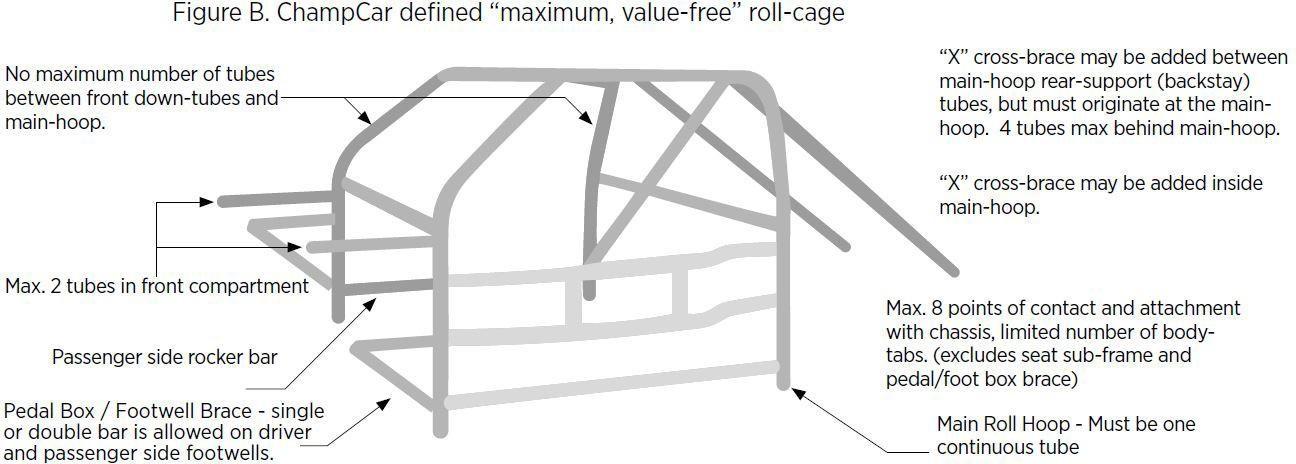
3.2.10.1The total number of mounting points does NOT include a sub-frame to support a seat mount, provided that the seat sub-frame does not exceed two (2) chassis contact pads. There is no limit to the number of bars allowed for free between the main hoop to the front A-Pillar down bars.
3.2.10.2The total number of mounting points does NOT include welded tabs connecting any hoop to the body. A “tab” is defined as being not greater than a 3/16” thick steel plate, no longer than six inches (6”), and a maximum of two (2) tabs may be placed within any 36” tube.
3.2.10.3The total number of mounting points does NOT include pedal box/footwell bracing contact pads.
3.2.10.4Where cages are attached to the vehicle unibody, tubes must be welded to a minimum 1/8” steel plates no less than 16 square inches in size.
3.2.11Additional Bars:
3.2.11.1Roll-cages may not have more than four (4) tubes installed behind the main hoop, and two (2) of these must include the main hoop rear-support (backstay) bars without value added. There is no limit to the number of bars allowed for free between the main hoop and the front A-Pillar down bars.
3.2.11.2Roll-cages MAY contain a maximum of four tubes (two per side) for pedal box/footwell bracing.
3.2.11.3Roll-cages MAY contain a maximum of 2 tubes inside the front engine or storage compartment, and each tube MUST terminate before the centerline of the front axle.
3.2.12Roll-cage Steel Tubing and Hardware:
3.2.12.1Minimum tubing size for cars weighing UNDER 2,500 pounds: 1.50” x .095”.
3.2.12.2The minimum tubing size for cars weighing over 2,500 pounds is 1.75” x .095” or 1.50” x .120”.
3.2.12.3For purposes of determining tubing sizes, the vehicle weight is as raced without fuel and driver.
3.2.12.4Properly bent, quality tubing is mandatory. No stretched or crushed bends are allowed. DOM mild steel is very strongly recommended over ERW tubing.
3.2.12.5The radius of all bends of the roll cage (measured at the centerline of the tubing) must not be less than three times the diameter of the tubing.
3.2.12.6All attachment points on the vehicle must be selected and reinforced as necessary so that, in an accident, the roll-cage will not punch through, tear, or grossly distort any roll cage attachment point. Heavily rusted floor pans must be replaced or reinforced with a sheet steel plate. Spreader plates, gussets, and/ or other reinforcing hardware are generally required to meet this goal. Minimum 1/8” (0.125”) (3.175mm) thick steel backing plates – not washers – must be present on the reverse or underside of any bolt in the cage location.
3.2.12.7All mounting hardware is to be SAE Grade 8/Metric Class 10.9 or better.
3.2.12.7.1Minimum bolt size is 3/8” or 10mm diameter.
3.2.12.7.2All nuts should be self-locking (Nylok® / ovalized), cotter-pinned, or drilled and safety-wired.
3.2.13All roll-cages / seats/drivers must be fit such that when the driver is securely belted in place, the top of the driver’s helmet does not extend above the centerline of the main hoop. This applies to ALL drivers on the team. Any driver found violating this rule will be black-flagged, and the car will be withdrawn from competition until repairs or modifications have been made and the car completes a re-tech inspection.
3.2.14All roll cage tubing must be padded with high-density roll bar padding wherever a driver’s extremity may contact the tube. SFI 45.1 Rated Roll Bar Padding is required wherever a helmet may contact the roll cage.
3.2.15To prevent the development of massively expensive roll cages that resemble tube-frame chassis, ChampCar has defined the “maximum, value-free” roll cage. The “maximum, value-free” roll cage includes all pads, points, tubes, and triangulations necessary to maintain an extremely high degree of safety while keeping costs in check and competition well balanced. Teams MAY exceed the design and application of the “maximum, value-free” roll-cage; however, additional value will be assessed by the Tech Inspector based on the perceived performance enhancement of the roll-cage.
3.3. DRIVER’S SEAT
3.3.1The back of all driver’s seats must extend in height to above the middle of the driver’s helmet or higher.
3.3.2One or two-piece SFI or FIA-rated competition seats are recommended. OEM seats are NOT allowed.
3.3.3All seats or seat sliders must be securely mounted to the floor or roll cage to avoid separation
during a crash. All mounting hardware must be SAE Grade 8/Metric Class 10.9 or better and a minimum 2-inch diameter or larger steel plate or load washers are required when mounting to sheet metal.
3.3.4All seatbacks must be permanently fixed, braced or otherwise restrained against forward and/or rearward failure. A one-piece, permanently mounted seat meets this requirement.
3.3.5All non-SFI or non-FIA rated seats must be within 3” of the shoulder harness bar or the diagonal main-hoop bar in its furthest forward position. For seats that do not meet this requirement, a seatback support MUST be used.
3.3.5.1The seatback support may be permanently attached to the seat. For those supports not attached to the seat, the support MUST extend such that the support plate or contact point of the support mechanism is less than one-half inch (0.5”) from making contact with the seat when it is in the furthest forward position.
3.3.5.2Seatback supports MUST maintain a minimum area of support contact of no less than sixteen square inches (4” x 4” square or 2” x 8” horizontal plate) and must be no less than 1/8” (0.125”) in thickness.
3.3.5.3All two-piece seats must have a permanently attached seatback support mechanism.
3.3.5.4Passenger seats must be removed for racing events.
3.3.6Seat Mounting - Teams are permitted to modify the OE sheet metal in the vicinity of the driver's position to permit safe mounting of the driver’s seat. Seat mounting materials and sheet metal used for these modifications do not incur points. However, ChampCar reserves the right to assess additional points if the modifications exceed what is necessary to safely mount the driver seat and add perceived performance enhancement.
3.4. RACING HARNESSES
3.4.1All drivers in ChampCar-sanctioned events shall utilize a five-, six-, or seven-point restraint harness system. A five-point harness is considered a minimum restraint system. Six- or seven-point systems are highly recommended. Harnesses may utilize 2” or 3” shoulder belts. PLEASE NOTE THAT NECK RESTRAINT SYSTEMS ARE AVAILABLE FOR 2” AND 3” BELTS, AND YOU MUST MATCH YOUR NECK RESTRAINT TO YOUR HARNESS.
3.4.2All driver restraint systems shall meet SFI or FIA specifications. The certification indicated by an SFI label or FIA label must be present. SFI Harnesses must display an in-date conformance label. FIA harnesses expire on December 31st of the expiration year tag sewn into the harness. The latest expiration may be used for harnesses with both FIA and SFI certification labels. Any attempt to modify the date(s) on any belt is grounds for immediate team disqualification, without recourse or refund.
3.4.3All driver restraint systems shall be installed per applicable manufacturer recommendations. ChampCar recommends carefully following these instructions to avoid common installation errors, including but not limited to missing cotter pins on snap locks, incorrect installation angles and distances, and incorrect shoulder harness wraps.
3.5. WINDOW NETS / ARM-RESTRAINTS
3.5.1All competition cars must have an SFI-approved window net mounted to the cage of the car only. All window nets must be installed so that the front edge intersects the plane created by the steering wheel. (Figure F) When securely belted in place, the driver’s arm should not extend beyond the wrist out of any portion of the window. Cars with nets that have extensive openings, as defined solely by ChampCar officials, will NOT be allowed on track.
Figure F
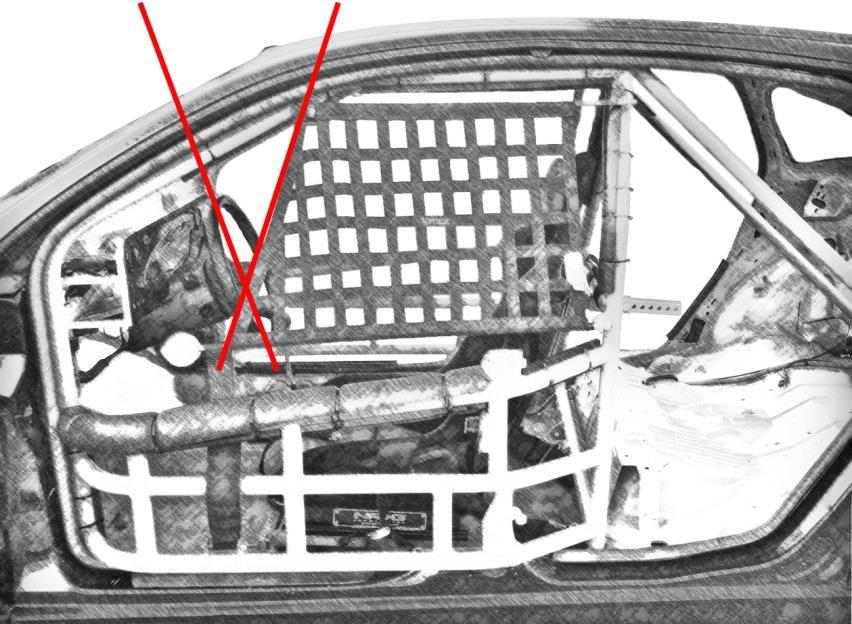
3.5.1.1All window nets shall meet SFI or FIA specifications. The certification indicated by an SFI label or FIA label must be present, including a clear “Date of Manufacture” label or, in the case of FIA labels, “Date of Expiration.” SFI nets list a year of manufacture, and ChampCar will accept them until December 31st of the fourth year from the year of manufacture. FIA nets expire on December 31st of the year of expiration sewn into net. Any attempt to modify the date(s) on any net is grounds for immediate team disqualification without recourse or refund.
3.5.1.2A small piece of deformable, transparent polycarbonate may be used to screen in an
the exposed area of the driver’s side window (left exposed by the window net) without value add PROVIDED the piece of screening plastic does not exceed eighty square inches and is a maximum 1/8” in thickness.
3.5.2ROOF NETS or SFI-CERTIFIED ARM RESTRAINTS ARE REQUIRED in all open (convertible) cars and/or cars with t-tops or sunroof openings.
3.5.2.1All arm restraints shall meet SFI or FIA specifications. The certification indicated by an SFI label or FIA label must be present, including a clear Date of Manufacture label or, in the case of FIA labels, Date of Expiration. SFI restraints list a year of manufacture, and ChampCar will accept them until December 31st, four years from that year. FIA restraints expire on December 31st of the year of expiration sewn into the item. Any attempt to modify the date(s) on any restraint or net is grounds for immediate team disqualification, without recourse or refund.
3.5.2.2Driver Arm Restraint Confirmation and Testing:
3.5.2.2.1At pit out, where all cars are required to stop, all drivers of open (convertible) cars and/or cars with t-tops or sunroof openings, without roof nets, shall be required to perform an arm restraint exhibition and test, by raising both arms to their maximum allowable height.
3.5.2.2.2At full vertical extension, the driver’s hands must NOT extend above a linear plane defined by the bottom edge of the lowest bar comprising the roll cage “halo.”
3.5.2.3Penalties
3.5.2.3.1Drivers of open (convertible) cars and/ or cars with t-tops or sunroof openings who fail the extension test at pit out will NOT be allowed on course. Drivers will be directed to remove their car from the pit out lane to a location that does not impede other cars and make the necessary adjustments to their arm restraints. Upon adjustments, they must complete the test at the availability of the pit out marshal.
3.5.2.3.2Drivers of open (convertible) cars and/ or cars with t-tops or sunroof openings
inspected at pit out who have not properly attached their arm restraints or roof nets or are completely missing arm restraints will be issued a 5-minute penalty at pit out.
3.5.2.3.3Drivers of open (convertible) cars and/or cars with t-tops or sunroof openings found at the pit-in without arm restraints or roof net and have been on track will be issued a 10-minute penalty at the pit-in.
3.6. DRIVER EGRESS
3.6.1It is critical that all drivers and crew members are well-practiced at releasing belts, cooling
tubes, radio wires, and any other attachments quickly. All drivers must be able to remove themselves under potentially life-threatening conditions quickly. IT IS EXTREMELY IMPORTANT THAT EVERY TEAM MEMBER PRACTICE EMERGENCY EGRESS BEFORE EVERY EVENT!
3.7. STEERING WHEEL LOCKS
3.7.1Steering wheel lock devices shall be removed or disabled. Quick-disconnect steering wheels are highly encouraged.
3.8. AIRBAGS
3.8.1All airbags must be disarmed and removed.
3.9. ONBOARD FIRE EXTINGUISHER
3.9.1ALL CHAMPCAR COMPETITION VEHICLES MUST HAVE A SELF-CONTAINED PUSH-BUTTON OR PULL-HANDLE FIRE SUPPRESSION SYSTEM INSTALLED.
3.9.1.1Fire suppression systems must have SFI or FIA certification.
3.9.1.2Minimum 5 LB or 2 Liter bottle capacity –ABF/AFFF/FE-36/NOVEC 1230 – Rechargeable systems are highly advised.
3.9.1.3Minimum two (2) extinguisher nozzles, one (1) pointed centrally towards the top and center of the engine, and one (1) located in the driver’s seating area and must be directed and have an unobstructed path to the driver’s body.
3.9.1.4Onboard Fire Suppression Systems shall be inspected for recertification at least every two years after the original certification date or as specified by the certifying manufacturer. A new conformance label marked with the inspection date shall be used when a unit is deemed acceptable for continued service. Infield recertification is permitted only by the original manufacturer or its authorized agent. Mailing of certification labels to customers is strictly prohibited. Systems shall have a maximum field service life of 6 years (SFI) or 10 years (FIA) from the original installation date.
3.9.1.5Teams using the ESS Fire Bottle must remove them from the car and take them to Tech to be weighed/inspected at every event the car is entered.
3.9.2All onboard fire systems shall identify the activation point for the automatic system by a circle “E” decal. Decals are available at ChampCar Tech Inspection.
3.9.3Cars arriving at pit in or pit out with the fire system arming pin not removed will be issued a 5-minute penalty.
3.10. DRIVER’S HELMET
3.10.1An undamaged full-face helmet, displaying Snell Type SA2015, SA2020, SA2025, or FIA certification is required.
Note: Snell Type M helmets (motorcycle) or other non-SA helmets are not rated for fire resistance and are not allowed.
3.10.2All helmets expire 11 years after the date of certification.
3.10.3Helmets showing any sign of abuse or accident damage shall not be used during a ChampCar event.
3.10.4Any driver with a helmet found with an altered or counterfeit Snell sticker shall be banned from that event.
3.10.5Sharing helmets between team members is very highly discouraged.
3.11. NECK RESTRAINT SYSTEM
3.11.1An undamaged FIA and/or SFI-approved racing neck restraint system is mandatory.
3.11.2SFI-approved neck restraint systems must display a valid SFI conformance sticker. Devices must be recertified every 5 years per SFI 38.1
3.11.3FIA-approved neck restraint systems must display a valid FIA conformance sticker. FIA devices do not require recertification; however, FIA guidance per Standard 8858-2010 must be followed.
3.12. FIRE RETARDANT CLOTHING
3.12.1Condition
3.12.1.1Any clothing that is worn, frayed, torn, has holes, grease/oil stains, or any other conditions that reduce or negate the item’s designed effectiveness shall NOT be used during a ChampCar event.
3.12.2Suit and Undergarments
3.12.2.1An FIA and/or SFI-certified racing suit is required.
3.12.2.2All driver suits possessing a valid FIA and/or SFI certification shall be allowed, regardless of the date of certification or manufacture.
3.12.2.3If using a single-layer SFI 3.2/A1 or 3.2/A3 suit, the driver must also wear fire-retardant SFI- or FIA-certified undergarments. Multilayer suits rated SFI 3.2/A5 or higher are highly recommended and may be worn without undergarments.
3.12.3Gloves, Socks, and Shoes
3.12.3.1Fire-retardant FIA and/or SFI-certified gloves, socks, and shoes are required.
3.12.3.2All gloves, socks, and shoes possessing a valid FIA and/or SFI certification shall be allowed, regardless of the date of certification or manufacture.
3.12.4Balaclava
3.12.4.1FIA and/or SFI-rated Balaclavas are strongly encouraged but are not mandatory. Balaclavas are required for drivers with beards or drivers with long hair that is not fully covered by their helmets. Hair protruding from beneath a driver’s helmet shall be completely covered by fire-resistant material. As an alternative to a balaclava, a full SFI- or FIA-rated helmet skirt may be used.
3.13. ANNUAL GEAR CHECK
3.13.1Gear inspection, use, and maintenance is each member's personal responsibility. Members are
required to annually inspect all personal safety gear and confirm it meets ChampCar minimum requirements. By accepting a member’s annual gear check, neither ChampCar nor its directors, officers, sponsors, staff, and/or officials ensure, certify, or warrant that the gear fully complies with all ChampCar rules or will prevent bodily injury, death, or other harm (including monetary damages). ChampCar expressly disclaims all consequential damages, regardless of the cause.
3.13.2Helmet Inspection and Annual Helmet Decal
3.13.2.1All drivers must present their helmet for inspection prior to on-track activity. Only the helmet is subject to inspection. Upon successful inspection, a ChampCar helmet identification decal will be issued. The decal is valid for the current racing year and must be affixed to the left side of the helmet, clearly visible to pit-out personnel. Decals may not be transferred between helmets. A dedicated helmet inspection station will be available on Fridays. On Saturday and Sunday, helmet inspections for late arrivals will be conducted at registration. Any driver arriving at pit out without a valid helmet identification decal will be sent back to their pit until their helmet has been inspected and stickered. Helmet compliance determinations made by ChampCar Officials are final.
3.14. BATTERIES
3.14.1All batteries must be installed in a safe location. All batteries must be fully secured via proper, purpose-built metal battery brackets, battery frames, or sealed battery boxes.
3.14.2Positive (“hot”) terminals must be in a sealed battery box or covered with insulating material.
3.14.3All batteries located in the driver’s compartment of the car shall be enclosed in a plastic, aluminum, or metal box.
3.14.4Lithium-Ion (LiCoO2) and Lithium-Polymer batteries are NOT allowed. LiFePO4, gel, and lead-acid batteries are permitted.
3.15. MASTER ELECTRICAL KILL (CUT-OFF) SWITCH
3.15.1All cars must have a racing-type master electrical kill switch securely mounted in a location accessible to and by the driver while he/she is secured in the driving seat by all seat belts and harnesses. The control or key for this switch should be red and the OFF position should be clearly indicated. Both the main battery circuit and the ignition circuit must be interrupted by the kill switch. All electrical cut-off switches shall be identified by the international lightning bolt symbol. Decals are available at ChampCar Tech Inspection.
3.15.2The dash or console switch MAY be the sole kill switch, or it MAY be a second switch, wired in series with an existing or additional switch located elsewhere on the car. If the switches are wired in series, interrupting either switch, independent of the other, must kill all power and vehicle operations.
3.15.3ALL terminals of the Kill Switch are to be treated as ‘hot” terminals and must be insulated.
3.15.4At technical inspection, the kill switch function will be tested by revving the engine to approximately 1500 RPM and turning off the switch. The engine must shut off immediately.
3.16. TOW HOOK
3.16.1All cars must be equipped with a suitable front and rear tow hook (or chain or strap), constructed of materials and installed so that they are capable of withstanding the tension required to extract your car. Minimum 2” diameter opening and easily accessible. Tow point must be clearly marked on car. Rigid tow hooks that protrude beyond the bumper are not permitted. Tow decals are available at Tech Inspection at no cost.
3.17. DRIVE SHAFT
3.17.1All cars that have modified the OEM driveshaft or swapped in a non-OEM driveshaft must use a driveshaft safety loop.
4. VEHICLE VALUE
4.1. TOTAL POINT VALUE
4.1.1Cars with total points in excess of 500 points will receive penalty laps (1 lap per 10 points over
the allowable 500 point maximum). Points will be rounded up to the next multiple of ‘10’. Greater than 500 and less than 510 will be rounded to 510, greater than 510 and less than 520 will be rounded to 520, and so on.
4.1.2Total Point Value of the race car is the combination of:
The Vehicle Performance Index
Non-Stock replacement or other added parts from the Fixed Point Value list
Non-Stock replacement or other added parts NOT on the Fixed Point Value list
Engine, transmission/transaxle, differential Swap Points
4.2. VEHICLE PERFORMANCE INDEX
4.2.1The Vehicle Performance Index (VPI) is the assessed value (by ChampCar) of the Performance
of the ChampCar competition vehicle. The VPI for the most common ChampCar Endurance Series vehicles can be found at https://champcar.org/web/register/vpi.php
4.2.1.1All models must be standard factory offerings. Special, custom, or limited editions are not included (Unless identified as such in the VPI).
4.2.1.2Factory supercharged or turbocharged vehicles must add 100 points to the listed value (Unless already identified as such in the VPI).
4.2.2If the make/model/year of a vehicle that you have an interest in racing is NOT listed, contact ChampCar through the Tech Desk system https://champcar.org/tech. New vehicles may be raced upon approval through the Tech Desk. New vehicles may be temporarily placed in EC pending a review of VPI value until an appropriate value is determined.
4.2.2.1Vehicles less than 15 years old will not be assigned VPI values.
4.2.2.2Vehicles more than 15 years old MAY be assigned a VPI value, at the discretion of the board of directors.
4.2.3VPI’s may be petitioned for review. A request for review is to be submitted to ChampCar through the Tech Desk system at https://champcar.org/tech
4.2.4Vehicle additions to the VPI table will be added quarterly. Adjustments to existing VPI, SPV, and SVPI values will be posted annually with the release of the new BCCR in the Fall. All changes will take effect on January 1 of the following year.
4.3. FIXED POINTS
4.3.1Non-stock Component Values: ChampCar has assigned a FIXED POINT VALUE that will be applied to MOST non-stock and/or performance components.
4.3.2Fixed Point Value List:
ABS, Non-OE, from a vehicle on VPI list: 25 pts
Aerodynamic Devices (See Appendix 1 – Aerodynamic Anatomy for more info) o Spoiler / Wing / Splitter / Diffuser / Aero Pan / Air Dam / Side Skirts: 10 pts/ea. Any added aero component outside of the defined components will be charged points based on the square feet of material
Alternator, non-OE and not from VPI List: 10 pts
Adjustable Cam Gear(s): 5 pts single, 10 pts multiple
Automatic Transmissions with 4 speeds (gears) or less, -75 points
With 5 speeds, -50 points
With 6 speeds, -25 points
With 7+ speeds, no discount.
An automatic transmission will still be defined as being coupled to the engine through a torque converter. Twin-clutch type transmissions will still be classified as a Manual Transmission.
Brake Caliper, 5-piston or more: 5 pts each
Camber/caster adjustable plates / extended ball joints / other apparatus:
o Aftermarket (pair): 20 pts front, 20 pts rear o Homemade (pair): 5 pts front, 5 pts rear
o Stock components (strut towers, suspension arms, subframes) redrilled/slotted for adjustment: 0 pts
Camshaft – non-OE or reground or reprofiled OE camshaft (Includes Springs, Lifters, Pushrods): 50 pts per engine
Carburetor: 25 points
Clutch, Multiple Disk system: 50 pts
CVs / axles, non-OE (pair): 25 pts
Cylinder head(s), non-OE and/or non-matching to your specific engine claimed. 100 pts per engine
Differential cover, non-OE: 5 pts
Differential swap: 25pts for any diff not originally available for your year, make, and model or chassis generation (excluding specialty high-performance models not listed on the VPI table). Includes axles and CVs
Distributor, non-OE, or non-OE ignition system (includes coils): 20 pts
Driveshaft, non-OE: 10 pts per single driveshaft
Dry sump assembly: 100 pts
Exhaust header: 25 pts per engine
Fiberglass/Composite Hood: 25 pts per engine
Heim joints: 5 pts each
Hub, non-OE: 2.5 pts each
Ignition coil(s), non-OE: 10 pts
Intake Manifold: 25 points
Mounts, non-OE, engine/transmission: 10pts per engine / 10 pts per transmission Any mount that does not change the vertical or horizontal position of the engine or transmission more than 1" in any direction be allowed for free.
Offset bushings: 5 pts/corner
Oil accumulator (e.g. – Accusump™): 0 pts
Oil cooler, non-OE (engine, transmission, and/or differential): 20 pts each
Oil pan, non-OE: 15 pts
Pulleys, engine accessory, non-OE: 5 pts for one pulley, 10 pts for multiple pulleys
Shock absorbers/struts with damping/rebound adjustment, includes remote reservoir, 25 pts per corner
Shock/strut tower reinforcement bar (commercial or homemade): 10 pts each
Suspension Springs, non-OE coil springs are 5-points per corner Exemption: Vehicles may replace OE coil springs for 0-points provided that the replacement spring:
Is the same shape as the OE spring (straight, frustum, beehive/keg, etc.).
Maintains the exact same ID/OD measurements as the OE spring (+/- 0.25”) when measured at the midpoint and at each end of the spring
Springs may be cut and/or used with spacers (spring rubbers) for no additional points
Shape and measurements must match when the springs are in their original unaltered condition
Torsion bars may be replaced with non- OE torsion bars for 0-points if they are used in conjunction with OE mounting points and hardware
Additional leafs may be added to leaf spring packs for 0 points if they are used with OE mounting points.
Adjustable spring perches, or any non-OE part or modification giving ride height adjustability, 10 points per corner. Any metallic spring may be used in conjunction with the adjustable corner for no additional points
Suspension component (not otherwise listed in this table), non-OE: 10 pts per corner per component
Sway bar, non-OE, including end links: 20 pts each axle
Sway bar end link, non-OE, including Heim Joint(s) – 5 points per corner
Throttle Body: 25 points
Transmission / Transaxle swap: o 25pts for any transmission/transaxle from a vehicle on the VPI list, includes adapters Any transmission on the VPI list that requires an adapter: 25 Pts
Tubular front or rear subframe/K-member (bolt-on only): 10 pts
Turbochargers and superchargers, non-OE: 100 pts o Parts included with non-OE turbocharger/ supercharger installations are: exhaust/ intake manifold, pressure tubing, cooling lines, oil lines, and boost control systems
Turbocharger and supercharger intercoolers, non-OE: 25 pts
Valve train, non-OE: 50 pts per engine
Valve Springs, non-OE: 10 pts per engine
Water Pump, Electric: 10 pts
Wheel spacers/hub adapters: 0 pts set of 4, max. 30mm/1.25” wide, max. 1/wheel
Materials will be charged at the following rate:
Interior bulkheads: 0 pts
Sheet aluminum/steel: 2 pts per sq ft.
Plywood: 1 pt per sq ft.
Sheet plastic/polycarbonate/fiberglass: 3 pts
CARBON FIBER: per sq ft. NOT ALLOWED
4.3.3ChampCar reserves the right to apply an additional point value to any component or part that substantially increases the value and/or performance of the car.
4.4. NON-FIXED POINT VALUE PARTS
4.4.1ALL non-stock components, parts, assemblies, or systems MUST be declared to Tech Inspection and declared and accounted for in the total points of the vehicle.
4.4.2There is NO SUCH THING as a free part, every part of a vehicle has a value. Parts not covered elsewhere in the rules will be assigned a point value by ChampCar Tech.
4.4.3Any vehicle found with missing (ground off) or tampered part numbers on any part or component will be immediately reclassified as EC.
4.4.4All point values assigned by Tech Inspection will be considered valid until ChampCar’s Board of Directors assigns a fixed point value.
4.4.5Carbon Fiber is not permitted anywhere outside of the driver’s cockpit
4.5. ENGINE SWAP
4.5.1Use the Swap Vehicle Performance Index Calculator at https://champcar.org/web/register/vpiswap.php to determine your vehicle’s total swapped value. The starting VPI of your vehicle when swapped may differ from the VPI of your un-swapped vehicle as listed in the VPI Index. This allows for substantially similar cars to be grouped together with the same starting value once the stock engine has been removed (I.E. All E30s start from 450 points) 4.5.2. The web page provides an automated calculator. The raw swap formula is:
IF [16 - (SPV / (HP + hpAdd) ) > 0 ]
THEN [ 0.032 * (16 - (SPV / (HP + hpAdd))) ^6] + 50 ELSE + 50
4.5.2.1“SPV” refers to the ChampCar Swap Performance Value of that make and model, as determined by ChampCar.
4.5.2.2“HP” is the stock horsepower of the original engine.
4.5.2.3“hpAdd” is the amount of extra horsepower being added to the car, not the HP of the new engine.
4.5.2.4All of the above variables must be taken from ChampCar’s database.
4.5.2.5All engine swaps that result in the same or a reduction of horsepower will be charged a flat 50-point fee.
4.5.3Engine swaps include stock long block, OE stock exhaust manifolds, stock induction system, motor mounts, wiring, and transmission adapters.
4.5.3.1Any OE exhaust manifold from a vehicle on the VPI List can be used on a swapped engine for zero (0) points. Aftermarket headers will be 25 points on all vehicles regardless of fitment issues.
4.5.3.2The intake manifold used in the swap must be the OE or stock intake manifold that came from the engine you are swapping into your vehicle. If you need to swap to a different intake manifold from what engine is going into the car then it will be 25 points.
4.5.4Maximum swap cost is $2500 (engine & adapters).
4.5.5Engine being swapped in must come from another vehicle in the VPI table, unless the Foreign Market Engine exception is used.
4.5.6Foreign Market Engine Exception:
4.5.6.1Foreign market engines are permitted with no additional point value provided they have the same displacement and construction as the OE engine in the vehicle and are within 3% of the US/Canadian advertised horsepower.
4.5.6.2Foreign market engines are permitted as substitutes for US/Canadian engines within the swap rule under the following conditions.
4.5.6.2.1Foreign market swap engine must be significantly similar to a US/Canadian engine
from a vehicle on the VPI list (Same displacement and construction) and be within 3%
of the US/Canadian advertised horsepower.
4.5.6.2.2Teams must use the US/Canadian advertised horsepower in the swap calculator.
4.5.6.3Teams are required to present documentation of US/Canadian advertised horsepower and Foreign Market advertised horsepower to tech.
4.5.7All other drive train components shall be stock. “Stock” is defined as the published specifications and technical measurements provided by the manufacturer.
4.6. PLATFORM SWAP
4.6.1As an alternative to an engine swap, teams may qualify for a platform swap. A platform swap is defined as replacing the original components with all the components from the same chassis family (i.e. – 318 to 325 BMW engine swaps or 2.8L to 5.7L Chevy Camaro). To qualify as a platform swap, all of the differing vehicle components must be swapped to match the new platform. This includes engine, transmission, differential, suspension, fuel tank, etc. The VPI of the car will now be based on the car and engine combination as presented to tech, regardless of what engine may have been installed originally. No swap surcharges shall be applied to platform swaps.
4.7. OTHER EQUIPMENT THAT DOES NOT COUNT TOWARD THE TOTAL POINT VALUE
4.7.1Teams may replace any worn, broken, ventilated, impaled, defective, or bent beyond all recognition parts on their car without affecting their total points, so long as it’s an OE or OE equivalent part for that car’s specific model.
4.7.1.1Teams may repair/replace rusted/fatigued/ damaged portions of the chassis with similar-thickness metal or OE-approved repair components/methods. Repairs must maintain some likeness to the original body lines of the chassis.
4.7.1.2Teams may remove parts or portions of parts from their car without incurring points.
4.7.1.3STOCK engine rebuilds are permitted. “Stock” is defined as the published specifications and technical measurements provided by the manufacturer. Manufacturer overbore rebuilds are permitted.
4.7.2Items that are point-free:
Air intake components ahead of throttle body (including air filter, air filter housing, air intake tubing, AFM/MAF)
Air vents to the driver
All fuel system components (Excludes the fuel tank/fuel cell)
Alternator (Must come from vehicle on VPI List)
All brake system components, excluding ABS units and brake calipers with over 4 pistons per 4.3.2.
Clutch, stock type single disc. Excludes smaller diameter or multi-disc clutches, see 4.3.2.
Cooling system hoses and vacuum lines
Coolant Expansion Tanks
Computers, ECU = Engine - TCU = Transmission – Includes Sensors o ECU, non-OE or chip replacement or chip re-programming o TCU, non-OE or chip replacement or chip re-programming
Driver comfort & information items are open and do not count towards total points (i.e. steering wheel, removable steering wheel adapter, shifter handles, gauges, pedals, cool suits, vents, heaters, radio communications, etc.)
Engine accessory brackets
Exhaust systems downstream of the header/ exhaust manifold (from the collector back)
Final drive ratio is open to all factory offered ratios for that body style or chassis generation. If that body style or chassis generation was offered from the factory with an LSD, its use is permitted. Specialty high-performance models not listed on the VPI table are excluded
Flywheel
Fuel Injectors / Carburetor Jets
Hood Vents
Hardware, fasteners, and materials used to attach things to other things (nuts, bolts, screws, rivets, duct tape, baling wire, zip ties, JB Weld, etc.)
Idler Pulley – Pulleys that only facilitate belt routing and do not drive any rotating pumps, gears, or shafts will be permitted no points.
Materials from your vehicle are permitted to be repurposed into other items for zero points, provided teams retain documented evidence of the process
Non-adjustable Shock Absorbers
Oil Pan Baffle
Oil pan skid plate protectors are zero points. Skid plates can extend no farther forward than the radiator and no further back than the firewall. Max width of 14”. Must be made of 10-gauge or thicker steel only. No plastic, aluminum, or fiberglass.
Pedal Assembly Sets
PCV (Crankcase Ventilation) system and hoses
Power Steering Components
Radiator
Radiator Cooling Fan
Remote Oil Filter & Lines
Shifters, provided the original function is maintained (Conversion to paddle shift or sequential shift is not permitted)
Starters
Shocks/Struts, non-adjustable for rebound/ dampening, no remote reservoirs
Suspension bushings, OE replacement or polyurethane/Delrin with OE geometry (OE hole location/offset, height, thickness)
Screens protecting radiator and brake duct openings from debris
Transmission swap – Any transmission can be used for free as long as it comes from a vehicle on the VPI list, is bolted to the vehicle’s OE engine, is of the same design (manual to manual), uses the same number of gears (5-speed for 5-speed), and no adaptors are required for it to bolt to the engine.
Valve Covers, non-OE
Water Pump, Mechanical
4.7.3Drive-by-Wire Throttle Bodies:
4.7.3.1Engines originally equipped with a drive-by-wire throttle body may replace the OE throttle body with a cable-operated throttle body from any vehicle on the VPI list, as long as the replacement throttle body has an equal or smaller flow diameter.
4.8. TIRE SPECIFICATIONS FOR ALL CLASSES
4.8.1All tires must be DOT-rated
4.8.2All tires must have a minimum tread depth of 7/32” or greater when new. All tires must have
been originally manufactured with a minimum tread depth of 7/32 inch or greater when new. Tires originally molded with less than 7/32 inch of tread depth are prohibited, regardless of the current measured tread depth or wear.
4.8.3All tires must have a UTQG treadwear rating of 250 or higher, unless specifically listed on the ChampCar Approved Tire List.
BFGoodrich g-Force Rival
BFGoodrich g-Force Rival+
Continental Extreme Contact Force
Falken Azensis RT615K+
Hankook Ventus RS4
Kenda Vezda UHP MAX KR20A
Kumho Ecsta V730
Maxxis Victra VR-1
Valino VR08GP
X Comp H/P
Yokohama Advan Neova AD09
4.8.4The ChampCar Approved Tire List is maintained and published by ChampCar and is the sole authority for tire eligibility.
4.8.5Approved Tire List Updates
4.8.5.1The Approved Tire List will be reviewed and updated on a quarterly basis.
4.8.5.2Any new tire additions to the Approved Tire List will be announced and published by ChampCar and will take effect immediately upon publication.
4.8.5.3Any tire removals from the Approved Tire List will be announced no later than September 1 of the current calendar year.
4.8.5.4Tire removals will take effect on January 1 of the following calendar year.
4.8.6Tire Size and Fender Coverage
4.8.6.1While tire size is open, tires may not extend beyond the coverage of the fenders from the 10 o’clock to 2 o’clock positions. Fenders may be stretched or rolled to cover wider tires, and flares may be added. Any additional materials used to enlarge the fenders will be assessed points at the material rate as outlined in Section 4.3.2.
4.8.7Technical Inspection and Compliance
4.8.7.1All cars on track at a ChampCar event must be equipped with approved and compliant tires.
4.8.7.2Any car presented for technical inspection with non-approved or non-compliant tires will fail technical inspection and will not be allowed on track until compliant tires are installed.
4.8.7.3ChampCar officials may inspect tires at any time before, during, or after an event. All tire eligibility determinations are final.
4.8.8Penalties and Enforcement
4.8.8.1Any car found to be using non-approved or non-compliant tires during an event or after competition will be disqualified from the event.
4.8.8.2A car disqualified for a tire violation will also forfeit its annual technical inspection.
4.8.8.3Loss of annual technical inspection requires the car to undergo full re-inspection at a future ChampCar event prior to returning to competition.
4.8.8.4Penalties related to tire violations may not be protested.
4.8.9Competitor Responsibility
4.8.9.1It is the sole responsibility of the competitor to ensure tire compliance.
4.8.9.2Claims of ignorance, supplier error, manufacturer changes, or lack of notice will not be accepted as justification for non-compliance.
4.8.9.3Teams are strongly encouraged to verify tire eligibility prior to purchase, installation, and competition.
5. SAFETY & TECHNICAL INSPECTIONS AND RELATED PENALTIES
5.1. INSPECTION PROCESS
5.1.1All competitors must present their vehicle(s) to ChumpCar International Inc., dba ChampCar Endurance Series (collectively, “ChampCar”), for annual safety and technical inspections.
5.1.2By inspecting a vehicle, neither ChampCar nor its directors, officers, sponsors, staff, and/or officials ensure, certify, or warrant that
the inspection will detect any or every problem with the vehicle;
the vehicle or any part of the vehicle is safe; or
the vehicle complies fully with all ChampCar rules.
5.1.3The inspection does not in any way change the fact that the driver, crew members, and vehicle owner are ultimately responsible for the safety, operation, and proper maintenance of the vehicle and personal safety equipment. ChampCar expressly disclaims all consequential damages, regardless the cause.
5.2. TECHNICAL INSPECTION
5.2.1ChampCar Digital Tech inspection forms should be completed using the ChampCar website prior to entering the tech line.
5.2.2Technical Inspections shall be done annually, and upon approval, a car will be issued a ChampCar Annual Inspection decal for that calendar year.
5.2.2.1Cars with a valid ChampCar Annual Inspection decal need NOT return for inspection UNLESS ANY OF THE FOLLOWING HAVE OCCURRED:
5.2.2.1.1The inspection decal has expired.
5.2.2.1.2The vehicle has undergone ANY major component exchange, swap, or replacement as a byproduct of an upgrade, repair, and/or modification.
5.2.2.1.3The vehicle has realized the upgrade, exchange, replacement and/or modification of any safety item, including but not limited to kill switch, seat belts or harness, seat and/or installation, roll-cage or attachment mounts, fire extinguisher system, window or roof nets, fuel cell, etc.
5.2.2.1.4The vehicle has been involved in ANY major contact or shunt. NOTE: Following any such incident the vehicle’s Annual Inspection decal shall be removed by the Technical Inspector.
5.2.3Appeals: The Technical Inspector’s ruling may be appealed to the Event Director. The Event Director’s ruling is final for that event. You may appeal for future races to the ChampCar Board of Directors at Board@champcar.org.
5.3. PENALTIES
5.3.1Cars with total points in excess of 500 pts will receive penalty laps (1 lap per 10 points over the allowable 500-point maximum. Points will be rounded up to the next multiple of ‘10’. Greater than 500 and less than 510 will be rounded to 510, greater than 510 and less than 520 will be rounded to 520, and so on.
5.3.2Penalty Lap Assessment Adjustments for Length of Endurance Racing Events:
5.3.2.1All penalty laps issued by Tech and/or as stated within the BCCR are applicable to 7-hour endurance racing events. Therefore, endurance event penalties shall be adjusted for longer endurance events:
5.3.2.1.1For races 8 hours or less, all penalties shall have a multiplier of 1.0.
5.3.2.1.2For races 9 to 16 hours, all penalties shall have a multiplier of 1.5.
5.3.2.1.3For races 17+ hours, all penalties shall have a multiplier of 2.0.
5.3.2.2ChampCar’s Event Directors shall have the ability to amend the multiplier to whatever factor is numerically related and/ or appropriate to the length of the track or event. If the Event Director chooses to amend the multiplier, the multiplier shall be specified in the Supplemental Rules of the event.
5.4. POST-RACE IMPOUND AND INSPECTION
5.4.1At the conclusion of every ChampCar Race, the top five (5) finishing vehicles, overall, and class winners, shall be impounded for a period not less than 30 minutes and not more than 90 minutes.
5.4.2During the impound period, the top five (5) finishing vehicles and class winners impounded must:
5.4.2.1Raise and place the car on four (4) jack stands, a minimum of 12” from the ground or floor level.
5.4.2.2Remove all four (4) wheels and tires.
5.4.2.3Open the hood and trunk.
5.4.3ChampCar will make the cars Tech Sheet and Swap Sheet available for review.
5.4.4ChampCar competitors and teams are welcome to “review” impounded vehicles. “REVIEW” does NOT mean touch or crawl under a competitor’s car however, you may request a ChampCar official to look at an item for you.
5.4.5During the impound period, the Event Director or Tech Chief may engage in any inspection they so choose, including but not limited to the partial or full disassembly of any assembly, system or component for legality.
5.4.6Upon the close of impound, all race results are final.
5.4.7Cars that have been found, whether during the event or in post-race impound, to be in violation of the rules will lose their annual tech sticker and be required to go through a new tech inspection process at each event the rest of the year.
5.5. PROTESTS
5.5.1Any Team Captain has the ability to file a written protest with the Event Director or Tech Chief regarding any car in the event. Protests must be submitted to the event’s Event Director or Technical Inspector after the race starts and before the post-race Impounds close. Protest forms are available in the “Rules” section of the ChampCar website.
5.5.1.1Driving Protest: Must include a written statement of the incident and be supported by video, OR two additional driver statements, OR the report of the Corner Marshal.
5.5.1.1.1Aggressive or unsafe driving protests accompanied by video or film documentation that do NOT offer a clear and concise view(s) of the incident or infraction or suggest any reasonable doubt will be defined as a “racing incident.”
5.5.1.1.2No protest will be accepted for missed or non-calls by corner workers or track/event officials, such as passing under yellow.
5.5.1.2Vehicle Protest: The protest must identify a maximum of five (5) items that may or may not be present on the protested car and are not claimed on the tech sheet.
5.5.2All protests must include a us$150 filing fee. A protest will result in:
5.5.2.1VALID PROTEST: A penalty is applied to the protested team, and the protest fee is returned to the protester.
5.5.2.2Valid driving protests penalties MAY result in penalty laps, a time penalty, or disqualification of the car, at the discretion of the Event Director.
5.5.2.3Valid vehicle protests will result in the disqualification of the car, or reclassifying the car to EC, or adjusting the Total Vehicle Performance Index (TVPI), at the discretion of the Event Director.
5.5.2.4INVALID PROTEST: No penalty is applied to the protested team, and the protest fee is lost.
5.5.3During a 2-day race event, in order to allow a team to compete the following day without having to rebuild any assembly torn down for post-race inspection, protested cars may have various assemblies or components marked and sealed for a delayed teardown inspection after the final race of the weekend. Any penalty applied due to illegalities found during a delayed inspection will be applied to ALL race events of the weekend.
5.6. DAY TWO HANDICAP
5.6.1For two-day endurance events (that is, two separate races), the winning car on day one will receive a lap penalty on day two equal to the number of laps they won by on day one plus one extra lap. No victory penalties will follow a team once the weekend of racing is over.
5.6.2Leaders who sandbag (drive intentionally slower) at the end of the race on Day 1 to reduce their Day 2 handicap will get a handicap lap added to their margin of victory that existed prior to the start of their sandbagging. Additionally, should the second-place car break or sandbag to force a larger handicap on the winning car, the handicap will be equal to the margin before the 2nd place car broke or slowed down.
6. ENTRIES AND TEAMS
6.1. ENTRY APPLICATIONS & PAYMENT DEADLINES
6.1.2ChampCar will refund any fees paid upon written request prior to the close of the event payment deadline (60 days).
6.1.3Inside of 60 days, any paid fees less the $250 deposit, will be transferred to another event.
6.1.4Inside of 14 days, fees are no longer transferable to any other event (exception for loss of car at another ChampCar event inside of this window).
6.1.5If you no-show for an event, all fees are lost. Don’t even ask.
6.1.6Early pay discount: The ChampCar auto-pay website will reduce the event fee by $200 for any full entry payment made 60 days prior to the event.
6.2. ENTRY & DRIVER FEES
6.2.1Entry fees for all ChampCar Endurance Race Events will be based on current track and support costs. See https://champcar.org for specific event pricing.
6.2.2Every entry includes all drivers and crew. Some tracks may charge entry fees outside of ChampCar’s fees. See the supplemental rules for that event.
6.2.3AMB 260X, AMB/MyLaps X2, or a MyLaps TR2 transponder is required to compete. You can bring your own or rent one from ChampCar.
6.2.3.1Rental transponders must have a factory MyLaps/AMB transponder mounting bracket affixed to their car in an approved location (see BCCR Appendix). ChampCar sells mounts at tech inspection. No loose, zip-tied, or duct-taped transponders are allowed.
6.2.3.2If a rental transponder is lost or broken, you agree to be charged for its replacement. If the case is cracked or deformed in any way, but the unit still works, you agree to be charged for repair and testing.
6.2.4To compete, you must have a Flagtronics FT200. You can bring your own or rent one from ChampCar.
6.2.4.1If a Flagtronics FT200 is lost or broken, you agree to be charged for its replacement.
6.2.4.2ChampCar strongly recommends the installation of the Flagtronics FT200 as described on page 48, Section 9.1.5. This will facilitate the use of the FT200 as a pit timer.
6.3. CATASTROPHIC FAILURE DISCOUNT
6.3.1If a ChampCar or EC competitor’s car experiences a catastrophic, non-repairable, mechanical failure (not the result of brain fade or collision while on the track) within the first two hours of the first day of any multi-day ChampCar Race event, ChampCar will extend a $300 discount to that team for their next ChampCar entry.
6.3.2If a team’s car experiences a failure during a ChampCar event that prevents the vehicle from attending another event the team has entered later in the season, ChampCar will transfer their entry fee or deposit for that later event to any even later event at the discretion of the Event Director.
6.4. MINIMUM DRIVER ENTRIES PER CAR
6.4.1Endurance Races:
8-Hours or less - Two (2) drivers minimum
9-16-Hours - Three (3) drivers minimum
17-hours and above - Four (4) drivers minimum
7. RULES OF THE ROAD
7.1. MAXIMUM DRIVING TIME
7.1.1Within an Endurance Race, no driver shall drive for more than 2 hours consecutively and shall have, at a minimum, sixty (60) minutes rest between stints.
7.1.2Driver stint time starts at Official Race Start (green flag) time for 1st driver, or when driver is released from pit lane after a driver change.
7.2. ON-TRACK DRIVER CONDUCT
7.2.1It is the responsibility of all drivers to avoid physical contact between cars on the race track. All competitors have a right to “racing room” on the marked racing surface. “Racing room” shall be generally defined as sufficient space on the marked racing surface to allow a competitor to maintain control of his/her car. CAR TO CAR CONTACT WILL RESULT IN A BLACK FLAG BEING ISSUED AND A TIME PENALTY TO BE SERVED.
7.2.2The responsibility for passing another car and accomplishing that pass safely rests with the overtaking driver. The driver that is about to be overtaken has the responsibility to be aware that he or she is about to be passed, give hand signals, and shall not impede the overtaking car.
7.2.2.1The driver being overtaken should, at all times, remain on their racing line unless the car is impaired and is unable to maintain an adequate racing speed.
7.2.2.2The driver being overtaken shall not block. Any driver who fails to make use of their rear view mirror, or who appears to be blocking another car seeking a pass, will be black flagged and/or penalized.
7.2.2.3It is the responsibility of the overtaking car to prepare for, plan, and execute a FULL and COMPLETE safe pass. The definition of a full and complete pass is when the overtaking car has extended a lead of approximately one car length ahead of the vehicle being passed.
7.3. STOPPING ON COURSE
7.3.1If a driver is forced to stop his or her car on the course, he or she shall make every effort to place the car in such position that it will not be a danger or obstruction to other competitors, course workers or themselves.
7.3.2Drivers stopping on course shall stay in their car with their seat belts firmly engaged and helmet in place until they are instructed by a corner worker or other race official to leave their car, UNLESS THE CAR IS ON FIRE.
7.4. PIT IN: UNSAFE DRIVER CONDITION
7.4.1Drivers arriving at pit in, having been on track, found with their window net down or seat belt unbuckled, will be issued a 10-minute penalty at pit in.
7.5. PASSENGERS
7.5.1Passengers are not permitted during a ChampCar race.
7.5.2Passengers may be allowed during a ChampCar test session at the event director's discretion.
8. RULES OF THE PIT
8.1. PIT AND/OR PADDOCK AREA
8.1.1Unless otherwise noted in the Supplemental Rules, all fueling must be done on pit road.
8.1.2While in the pits, each team entered in the event is REQUIRED to have ready a minimum of one (1) each:
8.1.2.1Ten (10) pound dry chemical or 3kg NOVEC fire extinguisher having a minimum UL 60 BC or ABC rating.
8.1.2.2Ten (10) pound bag of grease sweep, kitty litter or other absorbent for oil leaks and/or fuel spillage in their fuel storage area. (Having a broom is a good idea, too!)
8.1.2.3A suitable gasoline and/or liquid catch pan must be used during refueling in an appropriate position to catch any spilled fuel. All fueling / gasoline catch pans MUST be manufactured of metal or sturdy, chemical resistant plastic, maintain a minimum 3” depth, hold a minimum of 1-gallon (4-quarts) of liquid. Catch pans should be larger than 12” square or 12” in diameter. Oil drain pans work perfectly for this.
8.1.3Unattended fuel or oil spills are punishable at the discretion of the Event Director.
8.1.4All compressed air bottles/gas cylinders, with a pressure in excess of 200 psi, shall have a
protective structure around their gauges and valves when in the pit/grid/pre-grid areas.
8.1.5Unless restricted by the track, motorized paddock support vehicles are allowed PROVIDED that all drivers are 16 years or older and have a state issued driver’s license. Unsafe driving in the pits/paddock may result in a penalty or even disqualification of the associated team at the discretion of the Event Director.
8.1.6All used or junk parts too big for a normal trash can, empty fuel drums and anything else you brought with you must be taken out by you.
8.2. PIT STOPS AND FUELING OF VEHICLES
8.2.1NO FUEL JUGS OR CREW MEMBERS ARE ALLOWED ON OR OVER THE WALL UNTIL THE CAR HAS COME TO A FULL AND COMPLETE STOP.
8.2.2The fueling process starts when the gas cap is removed or whenever any fuel jugs are over the pit wall and ends when the gas cap is replaced and all fuel cans, catch cans, and drip pans are back over the pit wall. During this time, NO OTHER WORK IS ALLOWED ON THE CAR.
8.2.2.1Fire bottle operator must be in place before gas cap is removed.
8.2.3During fueling, any team member over the wall must wear a driver’s suit possessing a valid FIA and/or SFI certification. If using a single-layer SFI 3.2/A1 or 3.2/A3 suit, the team member must wear fire-retardant SFI- or FIA-certified undergarments. HOWEVER, any suit determined by ChampCar to be worn, frayed, torn, or have holes, grease/oil stains, or other conditions that reduce or negate the item’s designed effectiveness shall NOT be used during a ChampCar event. ChampCar’s decision is final. Fire-retardant FIA or SFI 3.3-rated socks and gloves are also required. FIA or SFI 3.3-rated Balaclavas are strongly encouraged but are not mandatory. Balaclavas are required for over-the-wall crew with beards or drivers with long hair not fully covered by their helmets. Hair protruding from beneath an over-the-wall crew helmet shall be entirely covered by fire-resistant material. A full FIA or SFI-rated helmet skirt may be an alternative to balaclavas. Standard closed-toe “street” shoes can be worn by over-the-wall crew. Leather boots are recommended. Non-driving over the wall crew members may wear an out-of-date Snell SA closed face with face shield helmet for pit duties. Crew members with out-of-date helmets shall mark both sides of their helmet with the words “FUEL ONLY” in 1.5”, high-contrast and easily identifiable letters.
ALL FACE SHIELDS MUST BE DOWN DURING THE FUELING PROCESS
Optional: The fueler is allowed to wear an SFI 52.1 fueler apron in addition to the above over the wall fueling gear.
8.2.4Each pit stop for fuel shall be a timed pit stop. The minimum time required per stop is five (5) minutes (pit in to pit out). Pit stops where fuel is not added to the car shall not be considered a timed pit stop.
8.2.5There is no minimum or maximum number of pit stops.
8.2.6All refueling jugs shall be DOT and/or ChampCar approved, with a maximum indicated capacity
of five (5) gallons. “Dry Break” systems are allowed. Funnels are not allowed to be used for the fueling process. All fueling must be done through a hose or dry break nozzle attached to the 5-gallon fuel jug. Overhead or elevated refueling rigs or electro-mechanical units to assist in lifting or supporting a fuel container are NOT allowed. All fuel jugs are to be manually supported. Only one fuel jug is permitted over the wall at a time.
8.2.7During the fueling process all cars MUST have their electrical kill switch in the OFF position.
8.2.8A MAXIMUM OF FIVE (5) PEOPLE ARE ALLOWED OVER THE WALL DURING FUELING.
8.2.8.1The driver exiting the race car MAY assist the driver entering the car, or MAY take one of the fueling positions. If the exiting driver goes over the wall, another appropriately dressed crew member may take his or her place.
8.2.8.2The driver entering the race car may ONLY be assisted with belts, radio connections, cool suit connections, and the window net during the fueling process.
8.2.8.3The crew member manning the fire bottle must manage an approved 10LB ABC fire
extinguisher and be stationed no less than 8’ and no more than 15’ from the point where fuel is being added to the vehicle. This team member is restricted from performing any other duty or function while managing the fire extinguisher; their entire focus is to be a safeguard in case of a fire. THE FIRE BOTTLE SAFETY CREW MEMBER IS NOT ALLOWED TO HANDLE FUEL JUGS.
8.2.8.4The crew member fueling the car may only fuel the car while the fuel cap is removed. All fuel jugs are to be manually supported. Only ONE (1) fuel jug is allowed over the wall at a time and only ONE (1) fuel jug is to be poured into a car at a time.
8.2.8.5The crew member assisting the fueling process may position the fuel catch pan and/or overflow vent catch can, etc. may assist the with the driver change.
8.2.9TEAMS ARE RESTRICTED FROM STORING MORE THAN 25 GALLONS OF FUEL IN THEIR PIT STALL.
8.2.10THE USE OF ELECTRIC PUMP(S) TO REFILL YOUR FUEL JUGS IS NOT ALLOWED. All pumps used to transfer any fuel shall be mechanical pumps.
8.3. PIT STOPS AND TIRE CHANGES
8.3.1NO TOOLS, EQUIPMENT, OR CREW MEMBERS ARE ALLOWED ON OR OVER THE WALL UNTIL THE CAR HAS COME TO A FULL AND COMPLETE STOP.
8.3.2The tire change process is in effect any time a team replaces a tire in the “Hot Pit” during a ChampCar-sanctioned event.
8.3.3During a tire change process, only battery and/or hand tools are permitted over the pit wall. No Pneumatic tools are permitted.
8.3.4During a tire change process, only 1 Lug tool (Battery or Hand), 1 Jack, 1 Torque Wrench, and Jack Stand(s) are allowed over the wall.
8.3.5Tire change process tool restrictions are only applicable to tire changes. These restrictions do not apply for any repairs, adjustments, or changes required to any other vehicle components, which may occur concurrently to tire replacement activities.
8.3.6All over-the-wall team members must wear long pants and closed-toed shoes. Short pants are no longer allowed over the wall at all ChampCar events.
8.4. RED FLAG CONDITION
8.4.1During a red-flag condition on track, any cars in the pitlane must cease being attended to by crew members until the race is back under Yellow-flag conditions. Drivers may stay in the car at their discretion, but if they get out, they may not get back in until the race is back under Yellow. No cars may leave the pitlane to the track or to the paddock under red-flag conditions. If the car was in the paddock prior to the red-flag condition, teams are free to continue working. No car may return from the paddock to the pitlane until the race back under Yellow.
9. MECHANICAL & ELECTRICAL SYSTEMS, ASSEMBLIES, COMPONENTS
9.1. GLASS – GENERAL
9.1.1Rear and Side glass may remain in the car provided it is covered by a clear safety window film (not tape, not tint). Example: 3M Scotchshield
9.2. WINDSHIELDS
9.2.1Cracked windshields will be carefully scrutinized. Cracks that are deemed a visual hazard to the driver or have the potential of losing their structural integrity upon impact by any object shall not pass Safety & Tech inspection, requiring removal prior to competition.
9.2.2OE windshields may be removed. Stock replacement windshields or polycarbonate (Lexan) windshields of the stock dimensions are acceptable in the stock location. Plexiglas plastic is not acceptable. If your OE safety glass or a stock dimension polycarbonate windshield is not installed, you must have a complete hood with no holes or vents in place as your firewall.
9.2.2.1All polycarbonate windscreens and/or windshields MUST have a nominal thickness of at least 3/16”.
9.2.2.2All cars with polycarbonate front windshields or windscreens are required to have front safety straps installed on the INSIDE of the cockpit to support the windshield and keep it from collapsing into the interior of the vehicle.
9.2.2.2.1A minimum of two (2) straps are required.
9.2.2.2.2Straps shall be 1 inch wide x 1/8 inch thick (aluminum or steel), and shall be bolted or riveted to the chassis or roll-cage at the top and bottom of the strap.
9.2.2.2.3The straps cannot be any further than 1” from contact with the front windshield.
9.2.2.2.4Placement of both straps should be approximately 12” apart and at least one strap may not be more than 12” from the centerline of the windshield.
9.3. SIDE & REAR WINDOWS
9.3.1No covering of any type is allowed in place of the passenger’s side window.
9.3.2ONLY clear, transparent polycarbonate is allowed in place of any rear side or hatch window opening without additional value-add, provided:
9.3.2.1A factory-installed (OE) window was standard equipment for the year, make and model of car presented to Tech.
9.3.2.2The window opening is located behind the driver’s seat or B-pillar (whichever is appropriate).
9.3.2.3All material must maintain a nominal thickness of at least 1/8”.
9.3.2.4All windows must be attached by screw, rivet, or bolt on a maximum 10” centerline around the perimeter of the window covering.
9.3.2.5The window covering must be the same size as the OE window.
9.3.3All polycarbonate rear windows or hatches are required to have at least two (2) 1” x 1/8” aluminum safety straps installed on the OUTSIDE of the window/hatch to support the window and keep it from separating from the vehicle. Straps must extend the full length of the window/hatch and must be securely attached to the chassis or roll cage.
9.3.4Rear and mid-engine vehicles where the rear window is an extension of the firewall may retain the OE-glass (MUST be covered by safety film) or add a replacement plastic panel with straps.
9.4. NERF BARS OR EXOSKELETON
9.4.1Added structural elements that extend beyond the outline of the original body line are not allowed. This includes additional structures holding lights or other components.
9.4.2Roll-cage main hoops and halo bars may extend above the roof.
9.5. BODY PANELS
9.5.1Hub caps shall be removed. All operable components of the vehicle’s body (e.g. – hood, doors, hatch or trunk lid) shall have a latching mechanism or be securely fastened.
9.5.2Each car entered must have a minimum of SEVENTY-FIVE PERCENT (75%) of the total body work and panels on the car. Vehicles must meet the "50/50" rule. This means vehicle must appear generally complete and be identifiable as similar to a stock version of the vehicle at 50MPH from 50 feet away. (See Appendix 2 – Chassis Modification Guide for more info).
9.5.3Doors cannot be removed. All cars must have a door or “OEM equivalent” body panel. Doors do NOT need to open or be operative. Doors may be welded closed. Doors may be re-skinned, however, re-skinned panels must be covered with the same type, thickness and quality of material as originally presented by the manufacturer (no aluminum panels replacing steel panels). Doors shall, in general, match the shape and contour of the originally designed bodywork, including at least 75% of the original height, as measured upwards from base of the door line.
9.5.4Body panels significantly supported or held solely in place by fabricated tubular, sheet metal and/or other forms of fabricated framework or brackets shall be charged for the materials associated with this structure. Body panels must maintain their original placement, shape and profile without the aid of other supporting brackets, rods, tubes or frames.
9.5.5All cars without stock dimension windshields must have a hood. In this case, the hood is considered a firewall and must be complete with no holes or vents.
9.5.6OE front and rear crash structures need to remain stock. Teams are not allowed to shorten, remove, or modify frame rails or significant portions of unibody structures outside of the wheelbase. This also includes cars with damaged or compromised OE crash structures. OE Equivalent replacement crash structures are an acceptable substitute.
9.6. SUNROOFS, T-TOPS, CONVERTIBLES
9.6.1All cars with sunroof and/or T-top openings must be covered by either a firmly attached
removable hardtop, the original sunroof panel, or a fabricated metal or fiberglass panel secured and fixed in place. Alternatively, they can be run as convertibles with the drivers wearing the required arm restraints or with a roof net installed on the vehicle.
9.7. CAR NUMBERS, CLASS DESIGNATION, AND VISIBILITY
9.7.1Car Numbers: One-, two-, and three-digit numbers are allowed.
9.7.2No cars may use “0” or “00” before their car number.
9.7.3Numbers must be shown on both doors, the front, and rear of the vehicle.
9.7.4Teams may contact their Event Director and arrange for a permanent car number.
9.7.5ALL CARS SHALL USE CHAMPCAR NUMBER BACKGROUND DECALS:
9.7.5.1Two (2) large and two (2) small OFFICIAL CHAMPCAR backgrounds are required. A third large background on the roof (or hood, if there is no roof) is optional.
9.7.5.2Electroluminescent numbers panels made in the same size and color scheme as standard panels are allowed.
9.7.5.3The required large number backgrounds shall be applied to the front driver and passenger doors of the car.
9.7.5.4The required small number backgrounds shall be applied to the front and rear of the vehicle.
9.7.5.5All present number panels must display the same number.
9.7.6ALL CARS SHALL USE BLACK NUMBERS:
9.7.6.1Numbers shall be at a minimum 8.0” tall.
9.7.6.2Fonts shall be a minimum of 1.0” wide (brush stroke) and a maximum of 1.5” wide.
9.7.6.3All numbers MUST fit within the standard ChampCar number white background panel. All permanent number requests will be granted based on prior year event participation and estimated 2025 participation. Permanent numbers will be assigned to teams that register for a minimum of four races during the 2025 season. All other numbers are on a first-come, first-served basis. email reg@champcar.org
9.7.7Other than numbers, no other decals, paint, tape, or themed items (of any type) are allowed on the ChampCar number background decal.
9.8. CHAMPCAR AND SPONSOR DECALS
9.8.1Each car competing in a ChampCar event shall display the official ChampCar Endurance Series banner at the top of the windshield. The decal must be unobstructed and in clear view. Backgrounds may be any color except White, Orange, or Yellow. For cars with no windshield, the Event Director will designate an alternate location for the banner.
9.8.2ChampCar will provide teams with other series sponsor logos, printed on a single decal, which must be displayed next to the ChampCar number panels on each side of the car.
9.8.3Other event sponsorship decals may be required.
9.8.4All sponsor decals will be provided at the ChampCar Tech Inspection. For installation directions and locations, refer to https://champcar.org/web/pdf/2023DecalPlacement.pdf.
9.8.5ChampCar reserves the right to remove any decal that may conflict with ChampCar sponsors or decals that we find in poor taste.
9.9. HEADLIGHTS, TAILLIGHTS, AND BRAKE LIGHTS
9.9.1All cars must be equipped with suitable headlights. Headlights may be OEM or aftermarket and must be mounted within 12" of stock locations. One must be mounted in each front corner (right and left side) of the car. Cars having more than four (4) light sources mounted on the car, whether working or wired for use, will be required to COMPLETELY REMOVE all lights above the count of four (4).
9.9.1.1CONVENTIONAL BULBS:
9.9.1.1.1No single light bulb or light source shall exceed 60W for H3 or H4 bulbs, or 35W for HID bulbs.
9.9.1.1.2Bulbs must match the housing and lens that they were originally designed for.
9.9.1.1.3No vehicle may have mounted fewer than two (2) or more than four (4) headlights. A headlight is defined by the number of illuminating bulbs or sources – not by the housing.
9.9.1.2LED FIXTURES:
9.9.1.2.1Cars equipped with LED head- or driving- lights shall be restricted to a maximum of 8,000 Lumens. Teams using LED lights MUST have documentation to prove Lumen data.
9.9.1.2.2No LED light bar may be longer than 18" in lens length.
9.9.1.3Combined Lighting Sources: cars using a combination of BOTH H3/H4/HID and LED lights shall be limited to a maximum of 4,000 Lumens of LED lighting and no more than two lighting sources using conventional H3, H4, or HID lights.
9.9.1.4All headlights must be installed such that the base of the driving light lens is NO HIGHER than six inches (6”) above the highest point of the stock front fender and NO FURTHER BACK than the centerline of the front axle.
9.9.1.5Headlights must be aimed properly, such that all light is directed at the track level.
9.9.1.6Cars not meeting these requirements or with improperly aimed or blinding lights shall be black-flagged and brought in to add, repair, or adjust lights to meet this requirement.
9.9.2Adverse Weather Events: All cars must have a minimum of two (2) operational headlights and two (2) operational taillights that remain on during rain/wet/fog/snow weather events, as deemed by ChampCar Officials. Teams will be notified that the lights must be switched on.
9.9.3Taillights: All cars must have a minimum of two (2) operational taillights that remain on at all times whenever headlights are on. Taillights may be OEM or aftermarket. No car shall have more than four (4) taillights. Taillight illumination shall be as bright or brighter than a 1034 or 1157 bulb but shall not be so bright as to overpower/outlight operating brake lights. Multifilament and combination brake/taillight assemblies are permitted.
9.9.4Brake Lights: Each car must have at least two (2) lights that are visible from 300 feet to the rear of the car. One Brake light is required in each rear corner (right and left side) of the car.
9.9.5Rear Rain Lights
9.9.5.1A rear rain light is recommended but not required.
9.9.5.2Placement MUST be in the vicinity of the license plate mounting location.
9.9.5.3Light is only permitted to be used during rain/wet/fog/snow weather.
9.9.5.4Light is NOT permitted to be used at night.
9.9.5.59.9.5.6. Rain light CANNOT function as a brake light at any time
9.9.6Headlight and taillight assemblies (and all associated hardware) are considered safety items and do not count toward your car’s total points.
9.9.7All glass and/or plastic taillight and brake light lenses that may be damaged from vehicle contact are to be taped over with clear packaging or other strong clear tape. Do not use Scotch tape.
9.9.8Accessory (Theme) Lights:
9.9.8.1Accessory lights are NOT ADVISED on or inside any wheel assembly (as the lights are often mistaken for sparks).
9.9.8.2Accessory lights inside the cockpit and driver compartment should be kept to a minimum. If the lighting is determined to be a nuisance to other drivers or race officials, ChampCar shall have the right to order the lights removed or turned off.
9.9.8.3No accessory lights are to look like or be mistaken for an emergency vehicle. Accessory lights may not blink.
9.10. FUEL SYSTEMS
9.10.1Zero Tolerance for Fuel Leaks. You will have only one chance to repair any fuel leak. If a ChampCar staff member detects a second instance of leakage, regardless of cause, your car will be removed from the race. No exceptions.
9.10.2Total fuel capacity, including all fillers and overflows, shall not exceed the OEM-stated fuel capacity for the make/model plus two (2) gallons. This applies to cars equipped with OE fuel tanks and to cars with approved fuel cells.
9.10.2.1ChampCar may verify total fuel capacity via the drain and fill method. The fuel tank is completely drained and then refilled with known amounts until fuel escapes the fill port.
9.10.2.2ChampCar competition vehicles with less than 13 gallons of OEM fuel capacity can upgrade to 15 gallons of fuel capacity (via a fuel cell installation)
9.10.3Surge tanks are limited to 2-liter (.53-gallon) capacity. Surge tanks do not count towards the total fuel system capacity.
9.10.4Fuel Tanks
9.10.4.1Stock fuel tanks in stock locations OR approved fuel cells are the only fuel sources allowed for competition.
9.10.4.1.1Stock fuel tank must not be altered in any way from OEM specifications. No cutting, hammering, ballooning, or other changes are allowed.
9.10.4.1.2Stock fuel tank vent lines and fill necks may be altered and/or relocated.
9.10.4.2NON-OEM REPLACEMENT OR SWAPPED FUEL TANKS ARE NOT ALLOWED. It’s either stock, in the stock location, or an approved fuel cell with the proper installation.
9.10.5Fuel Cells
9.10.5.1All fuel cells must have FIA or SFI certification. Fuel cells expire, as outlined in the FIA/SFI certification provided by the manufacturer.
9.10.5.2All cars equipped with fuel cells MUST have ball-check or sealable breather valves installed on all vents.
9.10.5.3All cars equipped with fuel cells MUST have roll-over closure or “flapper valves” installed at the fuel inlet port of the fuel cell.
9.10.5.4ALL FUEL CELLS AND FUEL COMPONENTS MUST BE ENCLOSED IN A METAL CANISTER/ ENCLOSURE.
9.10.5.5All fuel cells and fuel components (fill tubes, vent lines, etc) shall be separated from the driver compartment by a metal bulkhead. All lines and fittings that pass through the cabin of the vehicle must be metal or must be encased in continuous steel conduit or aluminum tube. The metal canister that makes up the fuel cell does not count as a bulkhead.
9.10.5.6Rotary-molded (plastic) fuel tanks are allowed as fuel cells provided they are SFI and/or FIA certified, foam-filled, and fully encased in a metal enclosure, as well as properly installed and supported in the vehicle.
9.10.5.7Fuel Cell Installation: If you decide to install a fuel cell, it must be securely mounted in a professional manner and must be installed in a safe location. All aftermarket fuel components must use threaded fittings and appropriate hose types, and include all appropriate racecar quality vents, valves, and other features. Fuel cell installation will be judged on overall execution and apparent safety.
9.10.5.8A reasonable protective and supportive square and/or round tubular structures may be installed around any fuel cell PROVIDED that the structure DOES NOT connect to, or tie into any suspension point or suspension pick up point, or add to the general rigidity of the chassis, or provide any performance advantage whatsoever. Fuel cell protective structures may be attached to portions of the main roll cage. Tech Inspection may assess additional points for any structure(s) that violate this rule.
9.10.5.9Fuel cells may be mounted in the passenger floor area of 2-seater cars or cars that have no space behind the driver’s compartment, provided:
9.10.5.9.1The passenger side has full NASCAR-type door bars.
9.10.5.9.2The fuel cell is enclosed by a full metal canister AND a separate bulkhead that encloses the fuel cell and canister. The fuel components (fill tubes, vent lines, etc.) must be separated by a metal bulkhead.
9.10.5.9.3All lines and fittings that pass through the cabin of the vehicle must be metal or must be encased in continuous steel conduit or aluminum tube.
9.10.5.9.4The mounting frame and attachments for the fuel cell should be constructed of 1” square or tubular steel, with a minimum wall thickness of 0.120”, and tied into the roll cage.
9.10.6Fuel Fillers and Fuel Lines:
9.10.6.1Vehicles may not have more than the stock number of fill ports.
9.10.6.23” MAXIMUM O.D. for all fuel fill lines.
9.10.6.3MAXIMUM -8 (AN) or 1/2” I.D. shall be used for all fuel lines from cell/tank to the engine.
9.10.6.4All fuel lines must be routed in the most direct (shortest distance) path to and from source/termination point.
9.10.6.5Any fuel, oil, or coolant lines (including Aeroquip steel braided lines) that pass through the driving compartment must be metal or encased in continuous steel conduit or aluminum tube. (Flex conduit is not acceptable. Lines wrapped in aluminum tape are not acceptable.)
9.10.7An overflow tube may be installed. Use of an overflow tube and overflow can DOES NOT remove the requirement for a ground positioned catch pan for spills. If installed, an overflow tube MUST meet the following requirements:
9.10.7.1Allow passage of vapor and liquid during the fueling process
9.10.7.2Not allow passage of vapor nor liquid while on track
9.10.7.3May not extend beyond the protection of the bumper
9.10.7.4Be constructed of a gasoline-resistant hose, no larger than 3/4” (0.75”) inside diameter
9.10.7.5Allow secure attachment of an overflow can with a minimum liquid capacity of 1 gal
9.10.7.6Overflow can must not be held by a person during fueling
9.10.7.7Overflow can may not spill fuel upon attachment or removal
9.10.8Fuel Tank Vents allow for passage of vapor, but do not allow for passage of liquid. Fuel Tank Vents are not subject to the restrictions outlined in section 9.10.7.
9.11. OIL CATCH TANKS, FILTERS, COOLERS, AND BREATHERS
9.11.1Non-stock engine, transmission/transaxle, and differential breathers shall be equipped with catch tanks.
9.11.1.1Minimum catch tank capacity shall be one U.S. quart.
9.11.1.2Catch tanks shall vent outside the driver’s compartment.
9.11.2Remote oil filters shall NOT be mounted in the driver/passenger compartment.
9.12. COOLANT
9.12.1Coolant must be water only. Antifreeze or anti-boil is not allowed. Red Line Oil’s “Water Wetter” or similar is allowed. A functional 1-Quart minimum capacity catch tank (overflow) is mandatory.
9.13. EXHAUST
9.13.1A professionally installed, quality exhaust system WITH MUFFLER is required.
9.13.2Exhaust systems must be designed, routed, and maintained to avoid the proximity of fuel tank(s) and/or fuel system components and/or driver compartments.
9.13.3Exhaust system shall not terminate in front of the main roll-cage hoop.
9.13.4Exhaust system must include at least two professional-quality flexible exhaust hangers behind the collector. All exhaust joints must be properly slip-jointed, properly bolted, or welded.
9.13.5All teams must maintain their exhaust in good condition throughout the event.
9.14. NOISE LIMIT
9.14.1ChampCar’s basic noise limit for ALL EVENTS is 96 dB at 50 feet from the track. Certain events may impose stricter noise restrictions – check all event supplemental rules. Excessive noise will result in a black flag and require repair before the vehicle can be readmitted to the race. A second offense will result in disqualification and removal from the event.
9.15. COCKPIT & FLAGTONICS
9.15.1All loose items in the cockpit must be removed or secured.
9.15.2Flagtronics FT200 Installation
Flagtronics FT200 units MUST be securely mounted to a rigid structure
The GPS antenna requires a clear line of sight to the sky
Teams are responsible for ensuring that the FT200 firmware is up to date
The FT200 battery must be charged for 24 hours before the event to ensure proper operation during the race
Teams are responsible for ensuring the FT200 has an adequate 12v 2-amp power source, and that the FT200 stays on during a pit stop, utilizing the battery built into the cable
The FT200 USB cable must be in an accessible spot in case any updates need to be applied
Teams are responsible for entering the FT200 unit serial number into the registration system when registering the car for a race
9.15.3Flagtronics FT200 Location
The FT200 must be mounted to the right of the steering wheel as shown in the image below
Within approx. 15in above the vertical centerline of the steering wheel
Within approx. 15in of the horizontal centerline of the steering wheel
All drivers of the car should be able to reach the device while belted in
Following the above guidelines ensures a clear view of the FT200 by the driver, along with a line of sight to the device by ChampCar pit lane staff, ensuring an efficient release onto the circuit.
9.16. MIRRORS
9.16.1All cars must have at least one interior mirror, one driver's-side mirror (or camera), and one passenger-side mirror (or camera).
9.17. ENGINE FIREWALL
9.17.1Openings or holes in the engine firewall under 2” diameter must be closed and sealed with a metal plate or OE-type grommets. Fireproof expanded foam fire block should be used around the roll bar through openings in any fuel areas or engine bay areas. Openings larger than 2” diameter must be closed and sealed with a metal plate that is bolted, welded, or riveted in place.
9.18. CAMERA MOUNTS
9.18.1The mounts for video / photographic cameras shall have a safe and secure design and be confined within the cockpit area of the vehicle (excludes rear view cameras). No cameras may be mounted outside of the driver’s area or cockpit. The camera's body (recording unit) shall be securely attached to the car's roll cage or interior bodywork. Helmet-mounted cameras are prohibited.
9.19. COOL SUITS AND DRINKING SYSTEMS
9.19.1Cool suits and drinking systems are allowed in all vehicles. Water tank and/or ice storage container mounts shall be safe and secure. No leakage of any kind is allowed throughout the system. ChampCar will Black Flag your car for any liquid leakage because we won’t know if it’s cool suit water or gasoline. Driver connections should be quick disconnects or breakaways.
9.19.2Cool suit coolers will be secured to the chassis using a minimum of a 1” ratcheting-type tiedown strap.
9.20. BALLAST
9.20.1Ballast shall not be added to any car.
9.21. BUMPER BARS / BASH BARS
9.21.1If the factory bumpers are removed from the car, a bar that extends no farther up/down/out/sideways than the factory bumper must be used in its place. The bar must attach to/cover the factory frame rails.
9.22. AERODYNAMIC DEVICES
9.22.1Aerodynamic devices not to exceed the width of unmodified OE bodywork (fenders, bumpers, doors). Note: Side mirrors are not included in bodywork width. Maximum wing height 12” above the roof. Maximum wing drop-back 12” behind the car. A splitter is any horizontal device installed from the centerline of the front axle, extending a maximum of 12” out of the front of the vehicle. An air dam is any vertical device installed from the nose of the bumper down.
9.22.2Wings may not be mounted forward of the centerline of the rear axle.
9.22.3Moving aerodynamic devices are prohibited.
9.22.4Definition of a 10-point wing: Uprights (mounts), endplates, and a single airfoil. Gurney flaps are permitted.
APPENDIX 1 - LEGAL
General
Right of Publicity: All participating cars, drivers, crew members and guests may be photographed, videotaped, recorded, or quoted, and by entering, attending and/or participating in any ChampCar event, you grant ChampCar the right to the use of such images and/or recordings including but not limited to use on television, Internet, within various publications and/or any other analog-digital broadcast or print media.
Any known medical condition (including pregnancy) which could affect medical fitness to compete shall be reported and identified on the event entry application. Any significant change in medical status from the date the entry has been submitted until and up to the start of the event, including cardiac or neurological problems, such as heart attack, heart surgery, strokes, seizures, any major surgery or diagnosis of cancer must be reported to the Event Director prior to that driver entering the track.
Each competitor and crew member is encouraged to have someone in their team maintain medical information about them in the event it may be needed by a medical treatment team. A driver who is involved in an accident in which his or her car rolls over, collides with a stationary object hard enough to cause structural damage to his or her car, who is aware of possible injury from an accident, or who is directed to obtain medical attention by an official shall report to the Event Director of the event as soon as possible.
A driver, crew member, official or staff worker/ volunteer at an event that is transported off-site to a medical facility shall not subsequently compete in or engage in any further activity at that event and may not enter any other ChampCar event without presenting a medical release signed by their personal physician.
A driver, crew member, official or staff worker/ volunteer who suffers loss of consciousness shall not subsequently compete in or engage in any further activity at that event and may not enter any other ChampCar event without presenting a medical release signed by their personal physician.
Entries and Teams
The organizers have the right to refuse an entry at their discretion without giving a reason for refusal. If an entry for any competition is refused, notification of such refusal shall be sent to the entrant at the e-mail address given on the Entry Form as soon as possible.
An entry which contains a false or incorrect statement may be determined to be null and void by ChampCar. The entrant may be deemed guilty of a breach of the BCCR, the entry fee may be forfeited, and further penalties may be imposed.
Children & Pets:
Parents or guardians of any minor shall be fully responsible for actions of their children. At SOME tracks children under the age of eighteen (18) MAY be allowed in the paddock or cold pit lane, under supervision by an adult. However, SOME tracks do not allow children in a cold pit lane. Each event’s Supplemental Rules shall state the track’s and/or event’s policy for children on COLD pit lane. Children are prohibited in the HOT pit lane, even with an adult. Any person signing an event waiver for a minor shall be held responsible for that minor. Children under the age of 16 are not allowed to drive any motorized- or gasoline-powered vehicle in the paddock or garage area at any racetrack. That includes golf carts, scooters, ATV’s, etc.
Pet owners shall be fully responsible for actions of their pets. When track rules permit, a pet may be in the paddock, provided it is enclosed in a vehicle or on a leash that does not exceed six feet (6’) in total length. When a pet is on a leash, it shall be controlled by an adult. Pets are prohibited in the pits. Pet owners are responsible for contacting the track to inquire about pet access and specific track rules. Track rules on pets shall always supersede ChampCar rules on pets.
APPENDIX 2 - AERODYNAMIC ANATOMY
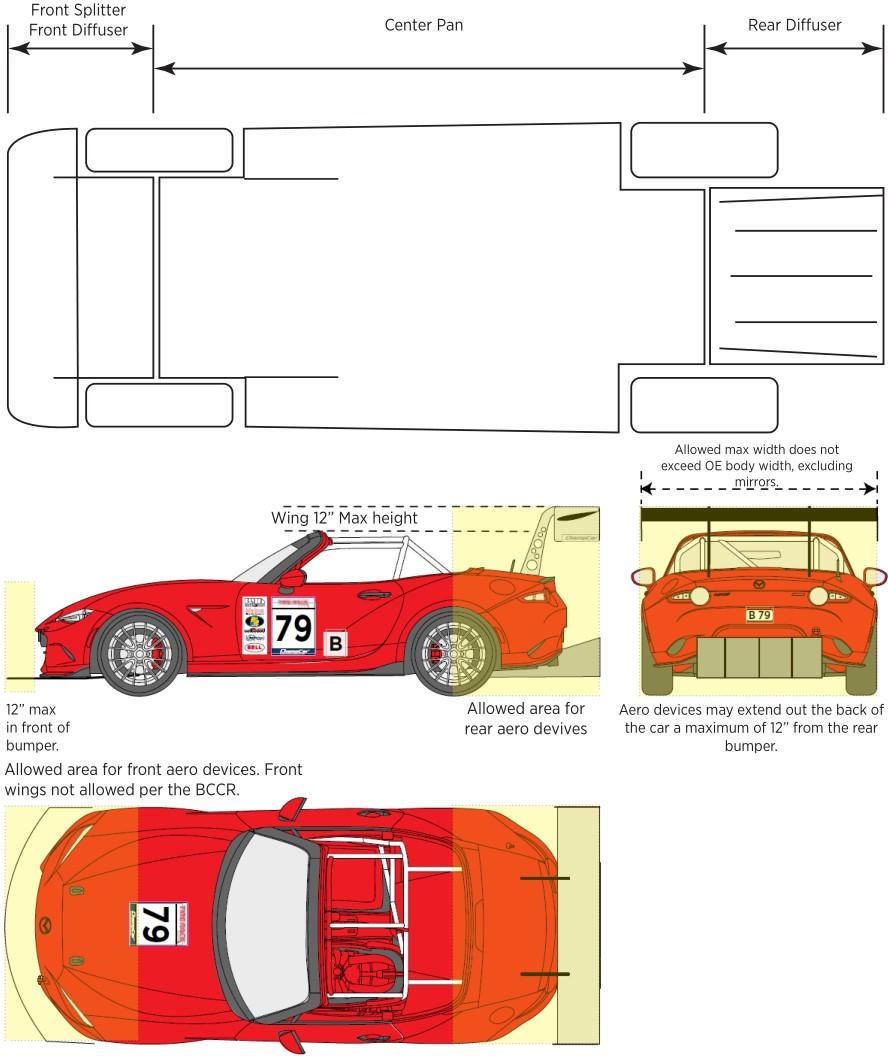
APPENDIX 3 - CHASSIS MODIFICATION GUIDE
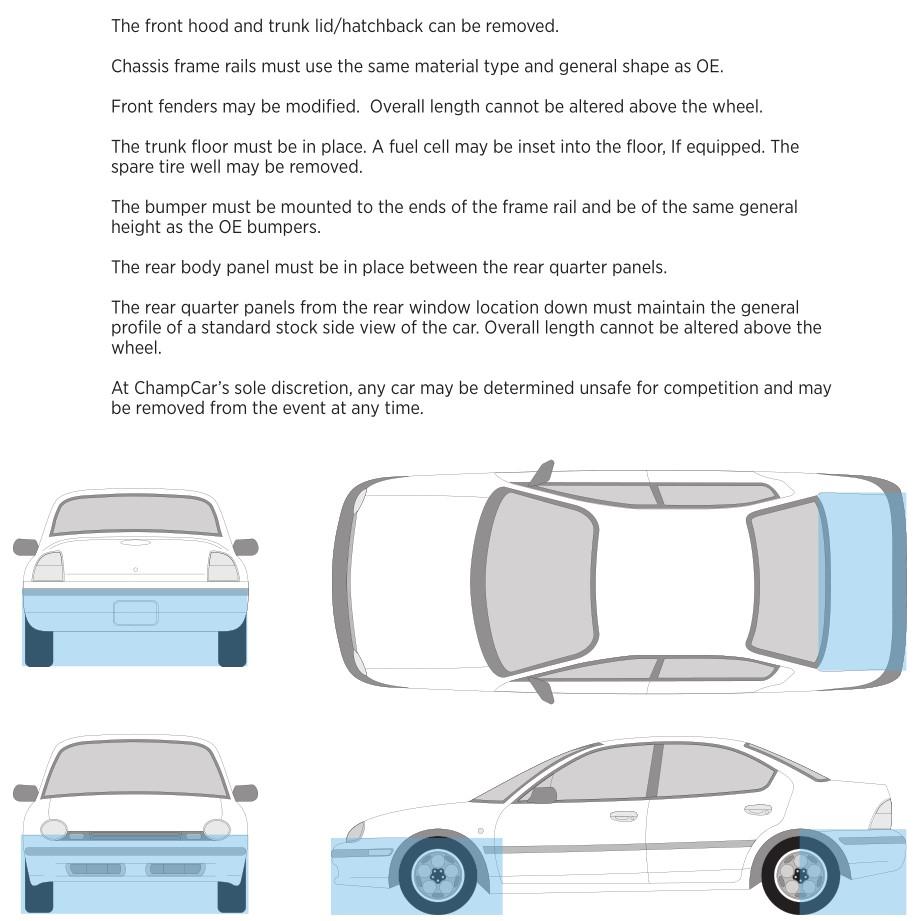
APPENDIX 4 – ROLL CAGE BASICS
Please visit https://champcar.org/web/rules.php#cage for a 3D interactive view of the cage.
All views are for left-hand drive vehicles. Reverse for right-hand drive vehicles.
Please visit https://champcar.org/tech to ask questions about safety equipment and cages.
Basic “NASCAR” Style Door Bar Roll Cage
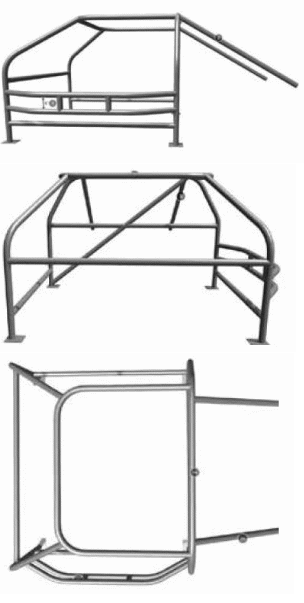
Contact Roll Cage Components for cage supplies or full cage builds.
https://rollcagecomponents.com/champcarendurance-roll-cage-kit
Basic “X-Bar” Style Door Bar Roll Cage
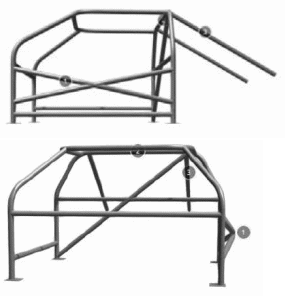
Tech Tip:
After the cage has cooled, take an inspection mirror, a small flashlight, and your finger and inspect all welds. Visually look for missing welds, and run your fingers across the welds to find missing fill.
APPENDIX 5 – TRANSPONDERS
To compete, you need an AMB 260X or AMB/MyLaps X2/MyLaps TR2 transponder. You can bring your own or rent one from ChampCar. Rental transponders must have a factory MyLaps / AMB transponder mounting bracket affixed to their car in an approved location. ChampCar sells mounts at tech inspection. No loose, zip-tied, or duct-taped transponders are allowed. If a rental transponder is lost or broken, you agree to be charged for its replacement. If the case is cracked or deformed in any way, but the unit still works, you agree to be charged for repair and testing.
Transponder Mounting Tips:
Always mount the transponder so that the black (AMB260X) or red (MyLaps TR2) is to the ground (not sideways).
You need to get a bracket (they’re only $10 and hold a $500+ unit in place).
Do not mount it near the exhaust, as the unit will melt.
Put it in a safe place where it will not get destroyed if someone “rubs” you.
There should be a clear line of sight to the ground with no objects between the transponder and the ground.
DO NOT cut a hole in the floorboard.
It is best to mount the transponder on the engine bay frame rail (away from hot exhaust headers/ turbo) or near the fuel cell/ tank.
Installation height should be 10” - 14” off the ground.
DO NOT mount to bumpers, spoilers, or easily damaged areas.
DO NOT mount using duct tape, zip ties, or wet chewing gum.
DO NOT just throw it on the floorboard, the door channel, or your driver's pockets.
If you entered a transponder number (or anything really) while registering, we assume you’re bringing your own. Please verify that you have entered the correct number or reserved a transponder if you’re not supplying your own. If you use a subscription-based MyLaps X2 / MyLaps TR2 transponder, ensure your subscription is up to date. When your subscription ends, the X2/TR2 will not count laps.
APPENDIX 6 – RACE CAR DECALS
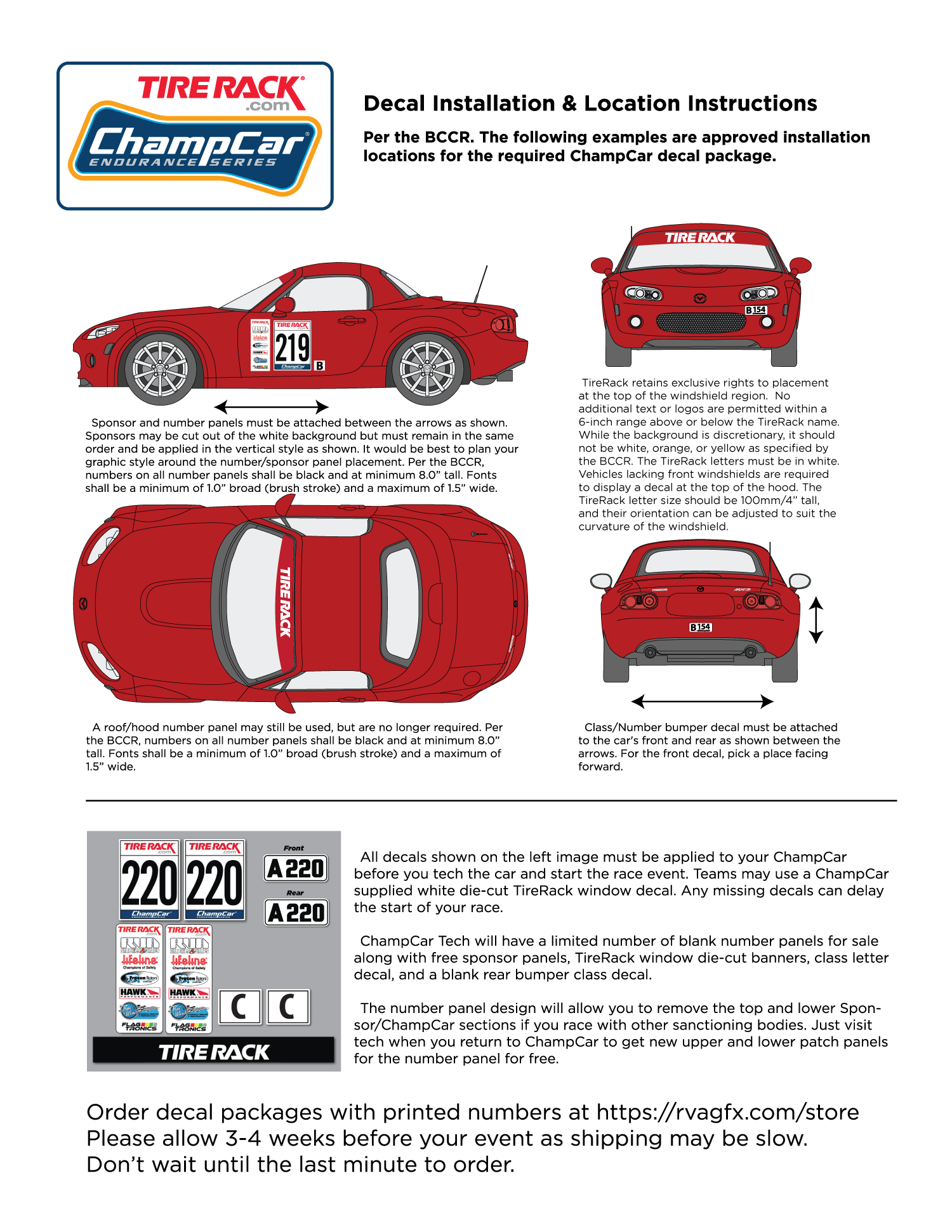
APPENDIX 7 – RACING FLAGS
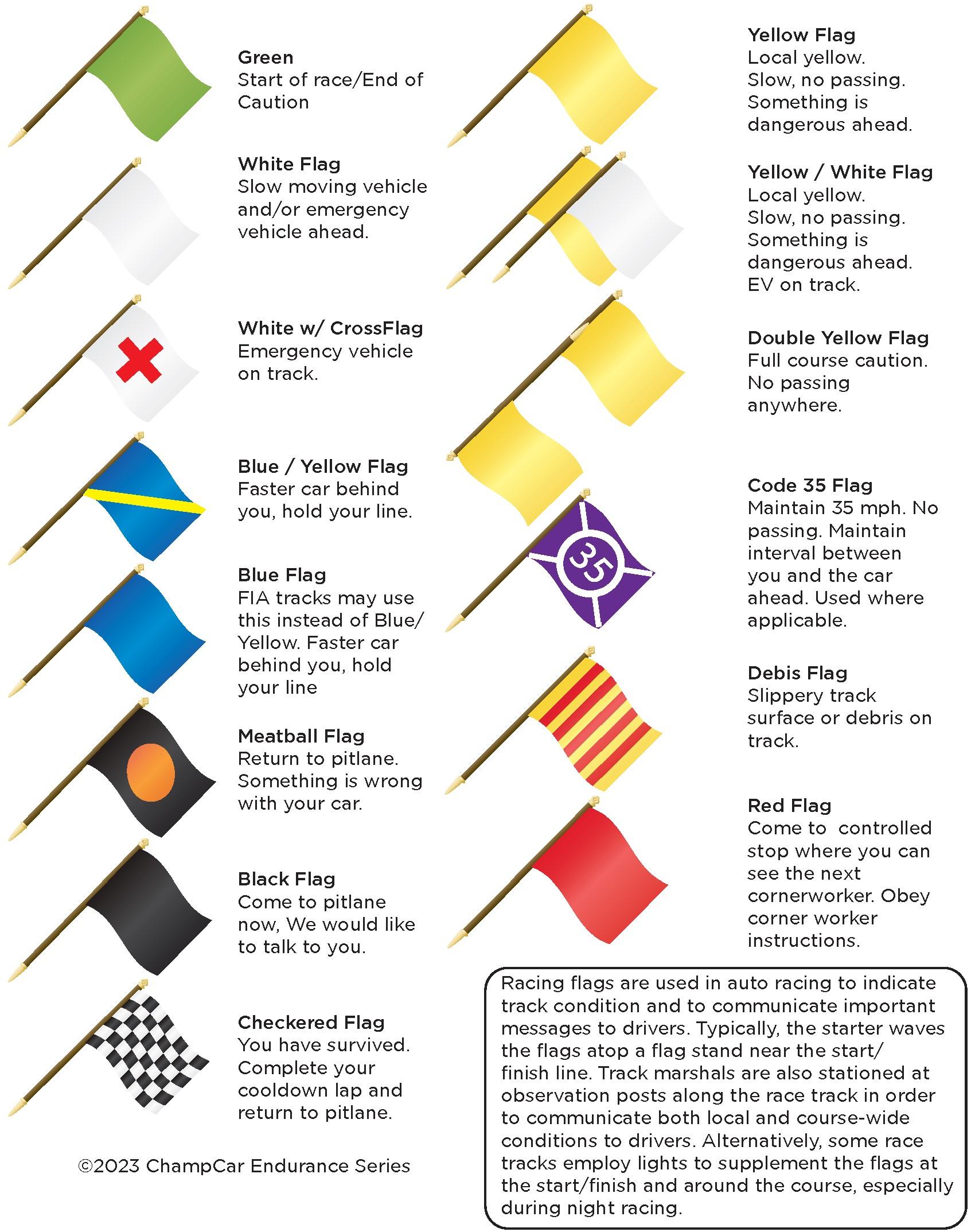
CHAMPCAR MISSION STATEMENT
ChampCar exists to provide people with a straightforward path to start road racing.
Real racing, wheel to wheel on America's greatest road courses.
However, it must be a hobby accessible to the average person. By offering racing in an endurance format, teams can be utilized, and
the cost can be shared between 2 or more drivers. Our rule book is
unique, and while sometimes controversial, it exists to keep a cap on the amount of money and speed required to race with us.
In ChampCar, all types of drivers race with us, from those entirely new to the sport to veteran pro racers. We believe that experience is the best teacher, and you will get all the experience you will need in one of our endurance events.
© 2009 -2026 ChumpCar International Inc., All rights reserved. ChampCar Endurance Series, ChampCar, CCES, and ChampCar.Live is a trademark and /or service mark of ChumpCar International Inc. The ChampCar logo is a service mark of ChumpCar International, Inc. and is fully protected.